Executive Summary
Most practices assume medical billing costs have to grow in lockstep with patient volume. More visits create more claims, which then require more staff, making true scaling challenging. But that assumption is a design choice, not an inevitability.
This guide breaks down how medical billing and revenue cycle management (RCM) becomes the ceiling of practice growth through linear headcount scaling, multi-location fragmentation, expertise bottlenecks, and informal workflows that break at scale. Then it lays out a practical framework for building billing operations that support growth without proportional cost increases by automating volume, centralizing and standardizing, and encoding expertise into systems so it’s not trapped in the heads of a few people.
How Medical Billing Becomes the Ceiling of Practice Growth
As practices grow, medical billing complexity increases, but staffing doesn’t keep pace naturally.

Revenue Cycle Management Headcount Grows as Fast as the Practice
As patient volume increases, most practices have to grow their medical billing and RCM team at nearly the same pace to keep up with claims, follow-ups, and denials. At some point, growth starts to feel expensive. Hiring and training medical billers and coders becomes a constant need, and billing turns into a bottleneck instead of a support function.
The core issue isn’t just volume. Rather, it’s that most medical billing work is still manual.
Multi-Location Growth Creates Medical Billing Inefficiency
As practices expand to multiple locations, medical billing often becomes fragmented. Each site develops its own workflows, habits, and workarounds—sometimes even using systems differently.
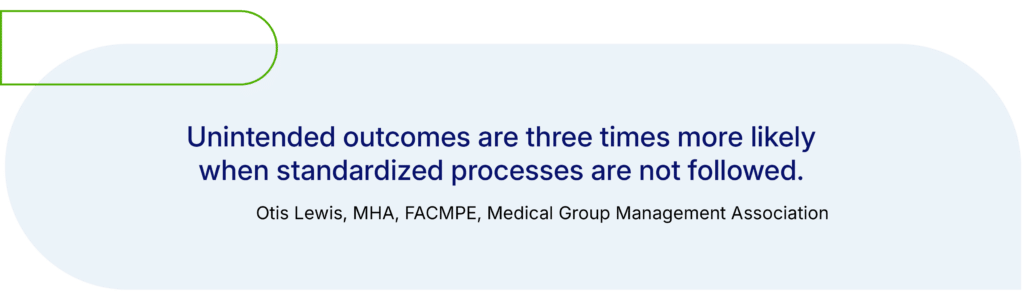
This is why what worked for one location doesn’t scale across five or ten. And, according to a fellowship paper published by the Medical Group Management Association’s (MGMA) American College of Medical Practice Executives (ACMPE), lack of standardization across multiple locations causes fragmented training, higher turnover, and lost funds. Plus, according to a separate article by MGMA, “unintended outcomes are three times more likely when standardized processes are not followed.”
Instead of gaining efficiency, the organization ends up duplicating effort and adding complexity. The result is higher costs, inconsistent performance, and limited visibility across the business. Growth adds revenue but also adds operational drag.
With smaller teams, you can get by with informal workflows. People know what to do, and communication fills the gaps. But as the organization grows, those informal processes start to break down. Different staff members handle the same situations in different ways, leading to inconsistent outcomes, more errors, and rework.
It also becomes difficult to train new hires, manage performance, or maintain quality. What worked at a small scale creates confusion at a larger one.
Medical Billing Expertise Becomes a Bottleneck
As practices grow, medical billing becomes more complex. Payer rules, coding requirements, and denial management all require experience. That expertise usually lives with a small number of people.
When only a few team members can handle certain issues, everything slows down. Work piles up behind those individuals, and the rest of the team can’t move faster without them. This creates a hidden ceiling on growth. And adding volume doesn’t help if the same few people are responsible for solving the hardest problems.
The Framework for Medical Billing Operations that Support Growth
By using automation for routine tasks, standardizing medical billing processes, and encoding medical billing systems with current payer rules and coding logic, you can create operational leverage, take the burden off staff, and scale without more headcount.
This isn’t exclusive to large health systems; a five-provider practice with the right infrastructure can operate with the same billing efficiency as a 50-provider group. Small organizations can achieve operational leverage that rivals large systems through intelligent infrastructure. The goal is medical billing operations that support growth without proportional cost increases.
Automate the Volume and Focus Your Team on Exceptions
According to the Health Affairs Scholar, administrative expenses for medical billing represent 20% of total healthcare spending in the United States. This reality represents a huge opportunity for medical practices that pivot to automation. When you automate routine claim processing and coding, your administrative team can focus on edge cases and process management instead of spending time on repetitive tasks that automation and AI can complete.
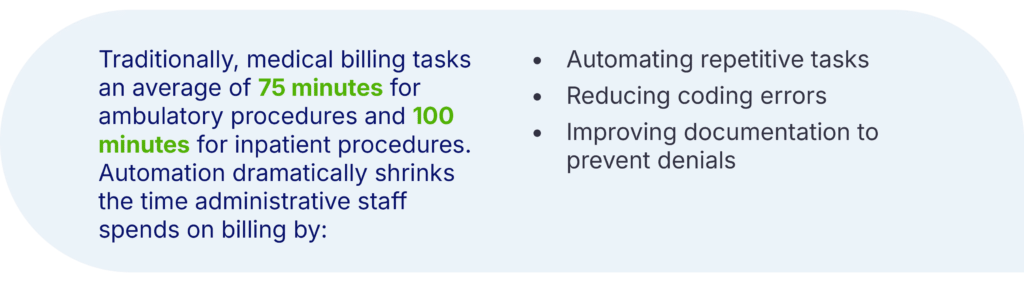
Admins are then handling significantly more volume without a proportional increase in overhead. This is why automating volume is a crucial first step. Staff shift their time to exception-based workflows where billers focus on denials and complex cases. This helps drive sustainable growth without constant hiring pressure.
You can also reduce rework by using automation to analyze coding for accuracy and flag questionable claims. This results in fewer errors and denials, which further reduces the burden on your staff or the need for additional staff.
Centralize and Standardize So Growth Becomes Replicable
Instead of managing medical billing operations in multiple locations, make the switch to centralize them. With centralized billing operations, new locations add revenue without requiring dedicated medical billing staff.
You can also standardize workflows, so every location follows the same process. Performance becomes consistent across the organization, and each new location starts generating clean claims from day one. The cost of opening a new location drops, and the time-to-revenue compresses, allowing for true scale.
In the same vein, start defining and documenting standard workflows across the RCM process, since this allows for faster onboarding and simpler training. Use systems that enforce consistency in how work gets done so that operations can scale without becoming chaotic.
Finally, consider using cloud-based systems that give teams shared access and visibility, giving leadership clearer visibility into medical billing operations.
Encode Expertise into System-Level Intelligence
Embed payer rules and coding logic into medical billing systems. By doing this, more of your team will be able to handle complex work with confidence. Next, use automation to handle routine decision-making, which results in less dependence on a small number of experts.
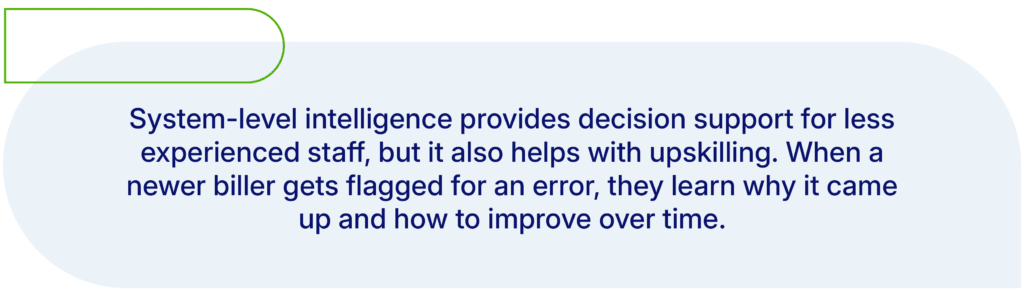
Then, provide decision-support tools that guide less experienced staff. Hiring and onboarding new staff become easier when the blueprint already exists. An added benefit is that the system doesn’t just enforce the process; it also teaches it. When a newer biller sees a flag, they learn why this came up and how to improve next time.
Design Your Medical Billing Operations for the Practice You’re Building Toward
The practices that scale most efficiently aren’t the ones that can hire the fastest, but rather the ones that build medical billing operations designed to absorb growth before it arrives. CollaborateMD by EverHealth is a cloud-based practice management and medical billing platform designed by medical billers, for medical billers. It integrates with any EHR, so practices aren’t locked into a single system. For practices expanding across multiple locations, CollaborateMD’s cloud-based architecture means every site runs on the same system, the same rules, and the same workflows from day one.
If your medical billing operations are the thing slowing down your growth, schedule a demo to make sure medical billing doesn’t become your bottleneck.