Executive Summary
Central billing offices do more than move billing work into one place. For multi-location practices and medical billing companies, they create a stronger operating model for visibility, control, and scale.
In fragmented billing environments, each location or client operates with its own systems, workflows, reports, and escalation processes. Leadership still receives reports, but metrics are calculated differently, workflows vary by team, and revenue issues stay hidden until they affect cash flow.
Centralized medical billing replaces that fragmentation with a shared operating model that standardizes reporting, oversight, workflows, and location-level data.
This guide explores how centralized medical billing gives leaders the financial visibility and control needed to compare performance, identify revenue risk, and manage growth across locations or clients with greater confidence.
Inconsistent Reporting Makes Revenue Cycle Performance Comparison Unreliable
Multi-location practices have access to plenty of reports, but that doesn’t automatically mean leaders have a reliable way to compare performance. Different locations may track the same revenue cycle metrics, including denial rate, clean claim rate, days in A/R, collection rate, first-pass resolution rate, and payer-specific denial trends, differently.
For example, Location A might calculate the denial rate based on total claims submitted, but Location B calculates it based only on adjudicated claims or closed claims. Both reports use the same metric, but the results don’t measure the same thing.
The Healthcare Financial Management Association (HFMA) MAP Keys framework underscores why this matters for multi-location organizations specifically: when KPI definitions and calculation methods vary by location, comparisons between sites measure methodology differences as much as actual performance.
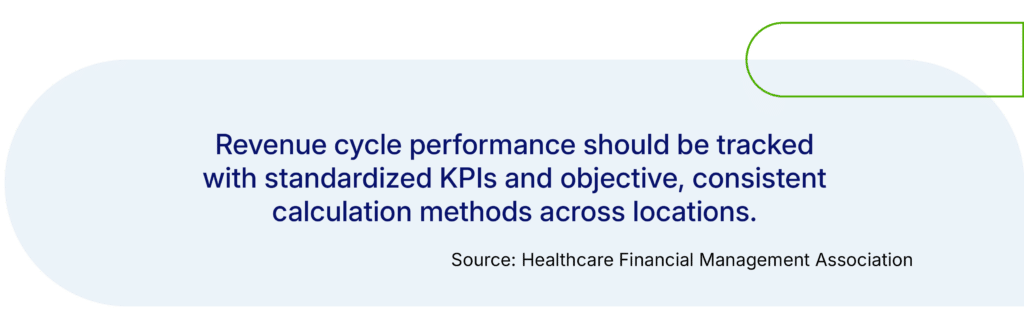
Without shared reporting standards, leaders cannot effectively compare performance or identify if performance gaps are real or just caused by inconsistent reporting.
Standardized Metrics Make Multi-Location Performance Manageable
Centralized medical billing helps organizations create one set of metric definitions across every location or client. Using the same calculation methods, timeframes, and reporting rules allows leaders to compare practice group revenue cycle performance without mixing inconsistent data.
Unified dashboards can show performance across entities, including denials, A/R aging, payer trends, and revenue, while still supporting location-level drill-down. Leadership can identify underperforming locations, investigate the cause, and strengthen multi-location billing management with more confidence.
Revenue Leakage Stays Hidden at Individual Locations
Revenue leakage happens when one location has billing issues that delay, reduce, or prevent payment. In a fragmented billing environment, those issues may develop at one location and go unnoticed for weeks or even months.
A location might have missed authorization checks, payer policy changes that affect a specific market, claims sitting too long without follow-up, rising denials from one payer, or underpayments that are not reviewed quickly enough.
According to a January 2026 Medical Group Management Association (MGMA) Stat poll, medical group leaders identified their biggest revenue cycle leaks as denials and appeals (48%), front-end issues (23%), billing and collections (14%), coding (13%), and charge posting (2%).
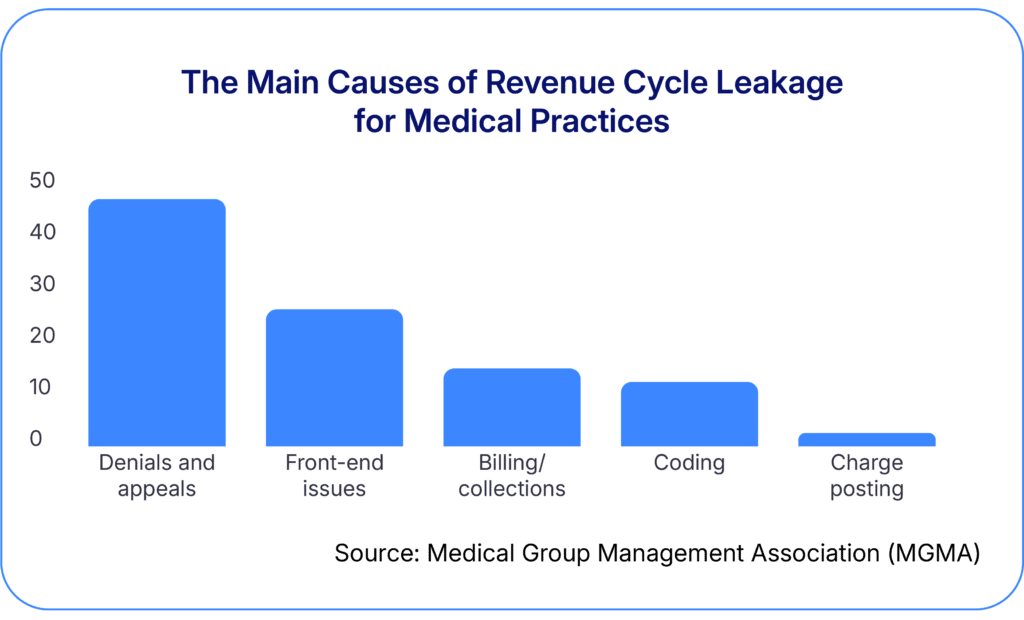
Without cross-location visibility, revenue risk stays trapped inside local workflows instead of being addressed as an organization-wide performance concern.
Multi-Site Medical Billing Oversight Helps Surface Revenue Risk Earlier
A shared view of location-level performance makes it easier for leadership to see when one location performs differently from the rest, whether it’s slower collections, rising write-offs, or payer-specific denial patterns. Comparative analytics also show whether an issue is isolated to one location or appears across multiple entities.
Better medical billing visibility gives leadership insight into every location’s financial health without manual reporting aggregation. With a more complete view of financial performance, leaders can detect issues earlier, intervene before they compound, and reduce revenue leakage.
Workflow Inconsistency Creates Unpredictable Medical Billing Quality
When billing is managed separately across locations, it’s easy for each team to develop its own way of completing revenue cycle tasks. A claim review step may be required at one location but not at another. Denial follow-up may be tightly tracked by one team and handled informally by another.
These workflow inconsistencies show up in coding reviews, charge capture, claim review before submission, denial follow-up, patient balance follow-up, or escalation rules for unresolved billing issues. The American Medical Association (AMA) identifies fragmented workflows and siloed practice functions as one of five critical barriers that impede effective revenue cycle management across practice settings.
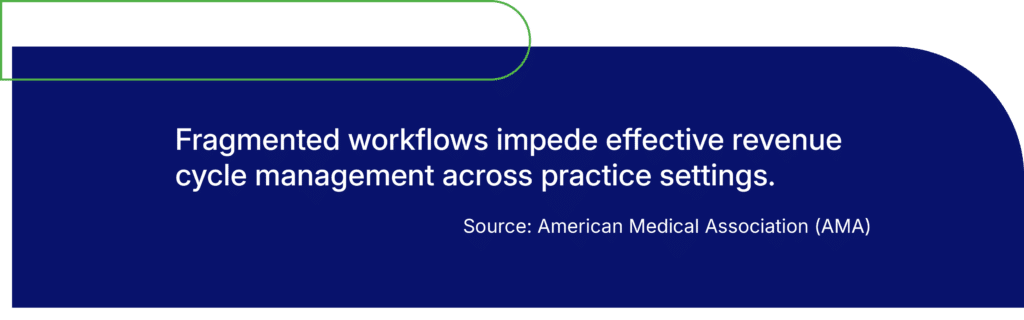
If workflows vary by location, billing quality can vary. Performance depends too much on local habits, staff knowledge, or site-level management, making improvement harder to scale across the organization.
Shared Medical Billing Workflows Create a Repeatable Model for Growth
Medical billing standardization across locations turns best practices into repeatable processes. Instead of rebuilding workflows for every location or client, teams can create one standard approach for documentation review, coding and charge review, claim review, and follow-up, and then apply it across the organization.
Centralized training, protocol management, and workflow monitoring help ensure teams are following shared standards. With one team, one system, and repeatable workflows, medical groups can scale more efficiently without increasing headcount.
Growth Planning Becomes Harder Without Unified Financial Visibility
Growth decisions require more than knowing whether providers are busy. Multi-location practices and billing companies need to understand what each location or client costs to support, how much revenue it generates, and what resources it requires to operate well.
Without unified financial visibility, decisions about expansion, new locations, new clients, staffing, and resource allocation become harder to make and justify. Data is spread across different reports, systems, definitions, and workflows, so financial planning becomes much less reliable.
Leaders working from incomplete information may rely more on assumptions than on real operating data when making expansion decisions.
Location-Level Data Helps Leaders Scale With More Control
Clear location-level data helps multi-location practices and billing companies understand the actual economics behind each site or client, including billing volume, collection performance, workload requirements, payer mix differences, and time to profitability.
With that foundation, leaders can identify which existing locations provide useful benchmarks for future expansion and use historical performance to set more realistic expectations for new locations, staffing needs, and revenue ramp-up. Unified medical billing also supports economies of scale by allowing new locations or clients to plug into existing infrastructure instead of building separate billing processes every time.
The Real Value of CBO Is Financial Coherence
The goal of a centralized billing office is not only to centralize billing work, but also to give leaders one consistent financial picture across every location or client. Having financial coherence helps organizations move beyond fragmented reports, compare performance more confidently, identify revenue risk, understand resource needs, and make stronger growth decisions.
CollaborateMD by EverHealth is built to support this model:
Unified revenue cycle management. CollaborateMD connects billing workflows, claims management, and financial reporting in a single platform. Multi-location practices and billing companies can monitor performance across every site or client account without consolidating data manually or reconciling reports from separate systems.
Standardized reporting and visibility. Built-in dashboards give leadership a consistent view of key revenue cycle metrics—including denials, A/R aging, payer trends, and collection performance—with the ability to drill down to the location or account level.
Intelligent claim prioritization. CollaborateMD’s automated billing workflows help teams surface issues earlier and focus on the claims and tasks most likely to affect cash flow. Rather than relying on manual review to catch problems, billing teams work from a prioritized, exception-driven queue that keeps revenue cycle performance on track.
AI-powered Universal Import. For billing companies managing multiple clients or practices exporting claims data from their EHR, Universal Import eliminates the manual work of data mapping and file preparation.
Using AI-guided column mapping to match exported EHR fields to CollaborateMD’s data structure, Universal Import seamlessly transforms raw files into billing-ready claims in minutes.
Medical billing companies and multi-site practices use CollaborateMD to simplify workflows, protect cash flow, and improve billing efficiency across accounts. Talk with an expert to learn more.