Executive Summary
The connection between a scheduled procedure and future revenue can look uncomplicated on paper. The patient is booked. The care plan is in place. The expected reimbursement has been factored into financial plans. But in procedural specialties, claim economics are rarely this straightforward because issues that put reimbursement at risk, like prior authorizations and payer pushback, are so common.
Payer delays or downcoding, changing eligibility rules, and inconsistent documentation standards can all influence reimbursement. A problem in any one of these areas can affect the amount ultimately paid. That uncertainty matters because procedure-focused practices often rely on a smaller number of high-value claims. A reimbursement shortfall on a routine office visit in primary care may have a limited financial impact. However, a shortfall on a procedure worth several thousand dollars is much harder to absorb. This distinction is why visibility into ambulatory surgical center (ASC) claim performance is so important. Without reliable procedural billing analytics, practices can’t identify where revenue is leaking.
Often, ambulatory practices discover issues after a claim has been submitted. The first indication of a problem is often a denial, and, according to the Healthcare Financial Management Association (HFMA), initial denial rates are higher than ever. In 2024, they reached 12%, up 2.3% from 2023. This is despite healthcare providers reducing prior authorization rates by close to 8%. Once a denial or another reimbursement issue comes in, teams are focused on recovering revenue rather than protecting it.
This guide examines the economics of claim complexity and provides a framework for understanding how different reimbursement risks affect the financial value of a case. It also explores how predictive analytics and greater visibility into claim performance can help procedural providers identify risk earlier, improve forecasting confidence, and make more informed decisions before claims reach the payer. For ASC practices managing high-dollar claims, understanding claim economics is becoming an increasingly important part of financial planning and revenue stability.
Why High-Dollar Procedural Claims Amplify Financial Risk
Understanding the main reimbursement risks procedural practices face and their potential impact on revenue is the first step to tackling complex claim risk management and moving toward greater revenue predictability.
Authorization Requirements Create Binary Financial Outcomes
A surgeon may know exactly what procedure a patient needs. The procedure may already be on the schedule, which should translate into future revenue for the practice.
But for procedures that require prior authorization, reimbursement is not guaranteed simply because the case is booked. An authorization denial can prevent expected reimbursement altogether. Additional review requests can delay payment. Both make it harder to predict what revenue the practice will actually receive and when it will receive it.
That becomes a bigger issue when each case is worth thousands of dollars. And it’s not a rare occurrence. According to a recent survey conducted by the American Medical Association (AMA), 27% of physicians report that prior authorization requests are often or always denied.

For practices that perform high volumes of authorization-dependent procedures, authorization performance isn’t simply an administrative task. It’s a core revenue stability issue.
Small Coding Variations Create Disproportionate Financial Volatility
A procedure may look like a $15,000 case when it’s scheduled. Then the claim goes out. A coding issue reduces reimbursement by a few hundred dollars.
On its own, that might not sound like a major problem.
But procedural specialties don’t usually rely on thousands of low-value claims. They depend on a smaller number of higher-value ones. That means small reimbursement changes show up much more clearly in the numbers. This isn’t a theoretical concern. The Office of Inspector General continues to identify documentation and coding inaccuracies as a significant source of improper Medicare payments, showing how closely coding and reimbursement remain connected.
One claim that comes in $500 below expectations may not change much. Twenty claims that come in $500 below expectations can leave a sizeable gap between the revenue a practice expected to receive and the revenue that actually arrives.
Those differences rarely appear all at once. They accumulate gradually across dozens of procedures, which makes them much easier to overlook than a single denial or payer dispute.
Multiple Complexity Variables Compound Exponentially
Most reimbursement problems don’t stem from a single issue. Consider a procedure that requires prior authorization. The authorization is approved. The claim is submitted. Later, a coding issue appears, and the payer tries to reduce the reimbursement amount. Then a documentation question follows.
Each issue may be manageable on its own. Together, they create a very different financial picture.
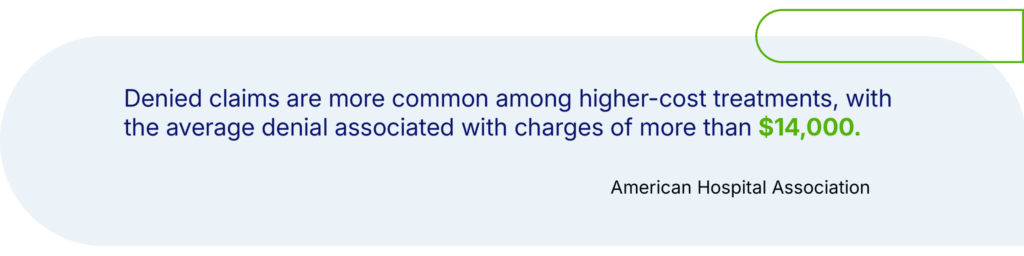
A recent American Hospital Association (AHA) analysis found that denied claims are more common among higher-cost treatments, with the average denial associated with charges of more than $14,000.
Most practices can spot individual reimbursement risks. The harder part is understanding what happens when several of them affect the same claim. A claim may appear straightforward at the start, yet produce a very different reimbursement outcome once authorization requirements, coding decisions, payer rules, and other factors begin stacking on top of one another.
By the time reimbursement falls short, it isn’t always obvious which issue caused the loss because no single issue caused it on its own.
Retrospective Oversight Makes Revenue Inherently Reactive
The time to address missing documentation, authorization issues, coding problems, or other reimbursement risks has already passed after a denial or underpayment arrives. Teams are left appealing decisions, chasing information, and trying to recover revenue that was expected from the start.
That reactive approach is expensive. According to the AHA, hospitals and health systems spent an estimated $19.7 billion in 2022 trying to overturn denied claims.
It also makes financial planning more difficult. A procedure that looked like a $10,000 case when it was scheduled can end up generating a fraction of that amount. When that happens repeatedly, forecasts become less reliable, and cash flow becomes harder to predict.
Most providers can tell you which claims were denied last month. What they can’t always see is how many of those denials shared the same underlying causes. The same problems often show up again and again. Different patients. Different procedures. Similar reimbursement outcomes.
That’s why many providers have started looking for warning signs earlier in the process, before a claim reaches the payer and before revenue is already at risk.
Building Predictive Financial Infrastructure for Complex Claim Environments
When a small number of claims drive a large share of revenue, identifying reimbursement risk earlier creates more opportunities to protect it. Here’s a framework to help your procedural practice optimize claim management with better visibility into claim data, trends, and future outlook.
Build Predictive Visibility Before Claims Are Submitted
Consider two procedures scheduled for next month. Both appear financially sound. Both are expected to generate similar reimbursement. But one carries a higher risk of running into authorization issues, coding problems, or payer-specific requirements.
Without modeled risk, both cases look equally healthy. With it, you can focus your attention on the claim that is more likely to create reimbursement problems before it reaches the payer.
You might discover that a procedure has a history of authorization delays. Or that a particular payer consistently reimburses below expectations for a specific service. Those signals are easy to miss once a claim has already been submitted. Seeing them beforehand creates a chance to address potential problems while the outcome can still be influenced.
Every issue you catch before submission is one less denial to appeal, one less reimbursement dispute to investigate, and one less payment delay to explain. Over time, this proactive approach can reduce the cost of rework, free up billing resources, and increase reimbursement performance.
Model Authorization Outcomes Using Historical Patterns
Many authorization decisions can feel unpredictable.
A procedure receives approval from one payer but faces delays or additional documentation requests from another. Over time, teams start noticing that some payers ask for more clinical justification, some procedures face longer approval timelines, and certain case types are more likely to trigger additional review.
You probably already have a sense of which payers create more work than others. But historical authorization data tells you whether your assumptions actually show up in the numbers.
You can then compare historical trends against real-time data to identify opportunities for claim management optimization. Research published in JAMA Network Open found that real-time transparency at the point of care was associated with shorter prior authorization turnaround times, suggesting that practices perform better when authorization requirements and status are easier to see and track.
But the benefit goes beyond faster authorizations. If a procedure has historically faced authorization challenges, you can account for that risk before the case even begins. Instead of assuming every scheduled procedure will generate the same reimbursement outcome, you can build a more realistic picture of what revenue is likely to arrive.
Practices that model authorization outcomes can forecast revenue ranges more accurately and reduce the financial variance attached to high-dollar cases before the case begins.
Quantify Compound Reimbursement Risk Across Complex Claims
With high-dollar claims, it’s even more important to understand how much risk each claim actually carries and whether you can see it before reimbursement is affected.
For example, a claim may be assigned a higher risk score because similar procedures have faced authorization delays, generated more denials, and taken longer to reimburse. Another claim may show strong historical reimbursement performance despite having a similar expected value.
Rather than relying on instinct, you can use predictive modeling to see which claims are most likely to create financial pressure before they reach the payer. Research in the International Journal of Multidisciplinary Research and Growth Evaluation shows that predictive revenue cycle tools can help identify likely denials, reimbursement delays, coding issues, and other claim risks before they affect financial performance. That means you gain the opportunity to address those risks before reimbursement is affected.
Predictive analytics helps you separate routine reimbursement risk from the cases most likely to affect financial performance. Instead of giving every claim the same level of review, you can focus additional attention on procedures that are more likely to face denials, reimbursement delays, underpayments, or authorization challenges.
Over time, that leads to better decisions about where to invest staff time, which payer relationships require closer monitoring, and which procedural service lines carry the greatest reimbursement risk. Revenue management becomes less about reacting to individual denials and more about understanding where financial pressure is building.
Shift Revenue Management From Reactive Appeals to Predictive Financial Control
Predictive revenue management starts with a simple idea: the earlier you can see a problem, the more options you have to address it.
Once reimbursement risk becomes visible earlier, the focus starts to change.
You’re no longer spending most of your time responding to denials and underpayments. Instead, you can begin identifying where revenue is most vulnerable before those issues appear.
This creates value in two ways: more revenue and more time.
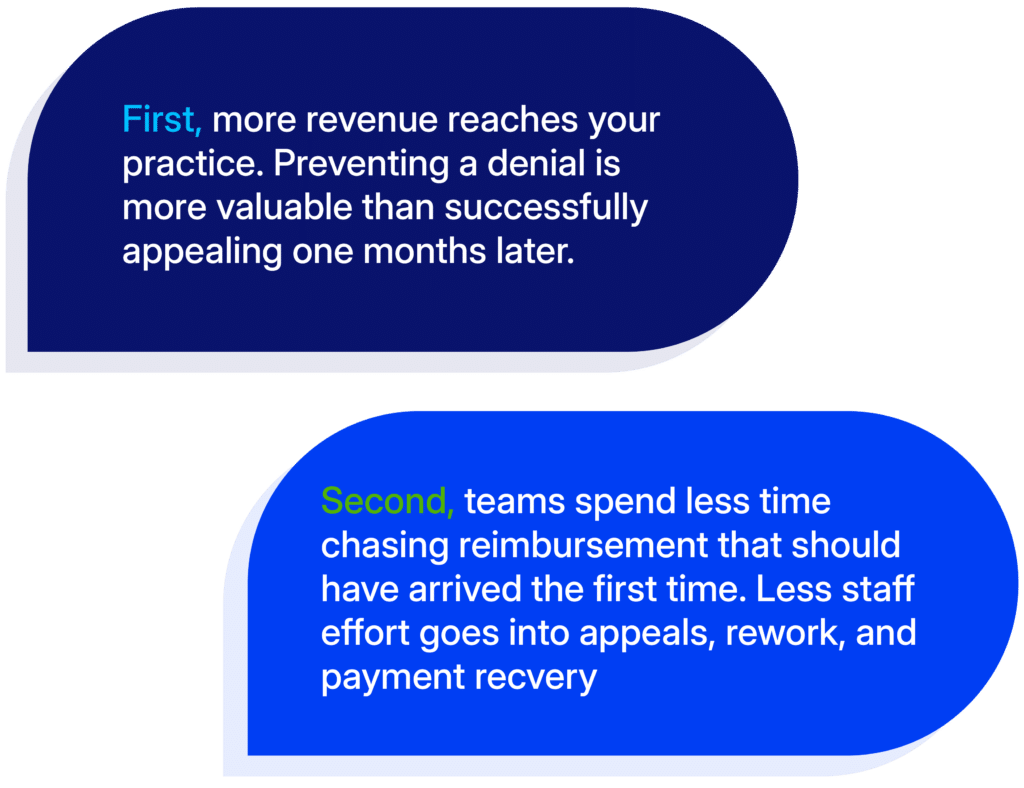
But the impact doesn’t stop at the claim level. When reimbursement becomes more predictable, you can build forecasts with greater confidence, plan around cash flow more effectively, and make decisions about staffing, investment, expansion, and resource allocation with a clearer understanding of what revenue is likely to arrive.
Predictive Financial Visibility: Essential for Procedural Revenue Stability
The financial value of a procedure is not determined by clinical care alone. Authorization decisions, coding accuracy, payer behavior, and documentation requirements all influence reimbursement long before payment arrives.
But when you can only see those factors after submission, reimbursement surprises start affecting much bigger decisions. Revenue arrives later than expected. Forecasts become harder to trust. Growth plans carry more uncertainty because future reimbursement is less predictable.
That’s why procedural claim complexity is ultimately a financial issue, not just a billing issue. The more clearly you can understand reimbursement risk before a claim reaches the payer, the more confidence you can have in future revenue. That confidence supports decisions about hiring, investment, service line expansion, and long-term growth.
This is where predictive financial visibility changes the conversation. It gives you a clearer picture of where revenue is likely to come from and where risk is concentrated, helping you plan more confidently for the future.
The right tools help you move beyond simply processing claims and toward understanding the financial patterns shaping reimbursement performance across your practice. This is where CollaborateMD steps in.
CollaborateMD by EverHealth helps bring that visibility together through analytics, reimbursement intelligence, and performance insights that support more informed financial decision-making across complex procedural environments. Talk with us to learn how CollaborateMD can help you gain greater visibility into reimbursement risk and procedural revenue performance.