Executive Summary
Most medical billing platform evaluations start with the wrong question. Buyers compare feature lists and assume more features mean better returns. They don’t.
Two platforms with identical features routinely produce dramatically different financial outcomes because implementation depth is what determines ROI, not feature presence. This guide reframes the buying decision around four dimensions that drive true returns and allows for scale in the long run.
Most Selection Frameworks Are Designed to Fail from the Start
Walk into the typical evaluation process, and you’ll find a spreadsheet of checkboxes. Does the platform handle eligibility verification? Electronic remittance? Claims scrubbing? These capabilities matter, but they’re the bare minimum your medical billing solution should offer. Almost every serious platform has them. Checking them off tells you almost nothing about the financial outcomes you’ll actually experience.
That’s the flaw at the center of feature-based selection. It measures the presence of capabilities rather than the quality of their implementation. A platform can technically “do” everything on your list and still fail to move collections, reduce labor, or surface the insight your leadership needs. Practices make buying decisions based on comprehensive feature lists, then discover that theoretical capability doesn’t translate into operational improvement.
A stronger framework starts from one question: will this platform collect more revenue, more efficiently, than what we have today? By evaluating the return on investment (ROI) of healthcare billing software, you can evaluate every candidate across the four dimensions that determine the answer.
These dimensions are integration, reporting, denial prevention, and scalability. For each, evaluate how the platform can drive bottom-line impact. For example, does it help with increasing efficiencies, better reporting, or growth enablement? You should walk away from a demo knowing what will improve, by how much, and how you’ll measure it.
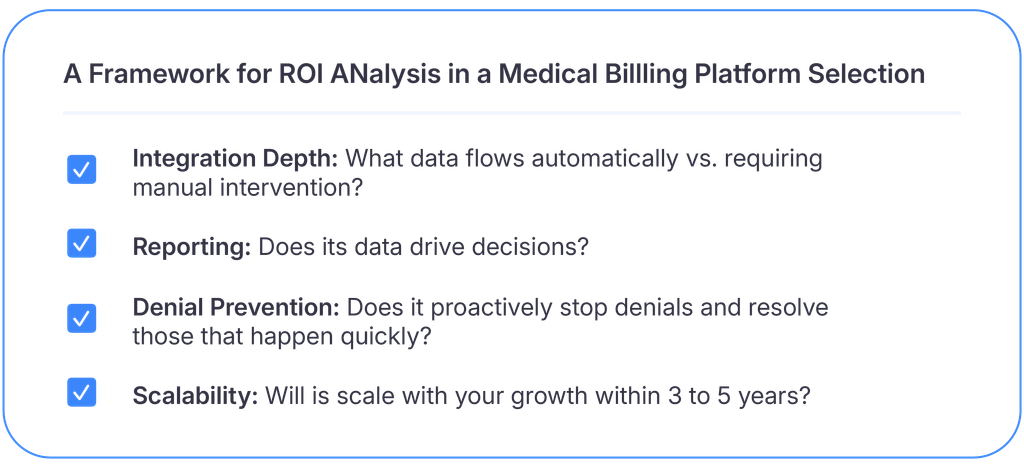
Let’s look at each dimension of the ROI evaluation framework in detail.
The Integration Dimension
Integration is where the most expensive surprises hide. A platform that doesn’t deeply integrate with your EHR creates data re-entry, workflow interruption, and administrative overhead that offsets any efficiency gains. The trouble is that “integration” on a feature list is a binary—it’s checked, or it isn’t—while integration in practice exists on a spectrum.
For instance, does data flow automatically or require manual exporting and importing? Does posting happen in real-time or in batches? Are workflow triggers connected or siloed? Shallow integration produces two systems that technically connect, but that might require manual bridging. This creates work instead of eliminating it.
Evaluate and Test for Integration Depth
Evaluate integration depth directly. Ask specifically what data flows automatically versus what requires manual intervention, then insist on seeing it. Require the vendor to demonstrate the specific integration scenarios your team runs every day. You shouldn’t accept a general claim that the systems “fully integrate.”
Practices that evaluate this way select platforms that reduce manual work instead of creating new bridging tasks. Their efficiency projections hold up because they’re based on demonstrated behavior. They avoid the integration failures that add administrative burden, and the ROI they modeled materializes because the automation works in production, not just in theory.
The Reporting Dimension
Plenty of platforms generate impressive volumes of data and almost no insight. Leadership ends up with dashboards full of metrics and no clearer sense of what to do differently. This gap between data access and decision support is a real ROI factor because a platform that surfaces decision-relevant visibility drives better management than one that simply reports activity.
Evaluate for Decisions (Not Just Data)
The deciding variable to evaluate is usability. Can the people who set strategy actually use the reporting to make decisions? Evaluate a potential medical billing platform for decision relevance, not data volume.
Does a report answer a leadership question, or does it just display numbers that still need interpreting? Test it with the practice owner or administrator who’ll rely on it, not only the medical billing staff already fluent with the system. You need to know whether insights surface on their own or require hours of analysis to extract. You can also ask for a demonstration of the reporting against a specific decision your leadership faces.
When reporting clears that bar, it changes behavior. Leadership engages with medical billing data because it’s accessible and actionable. The practice responds to problems faster because the reporting is decision-ready. And the investment returns value through the decisions it enables and the outcomes those decisions improve.
The Denial Prevention Dimension
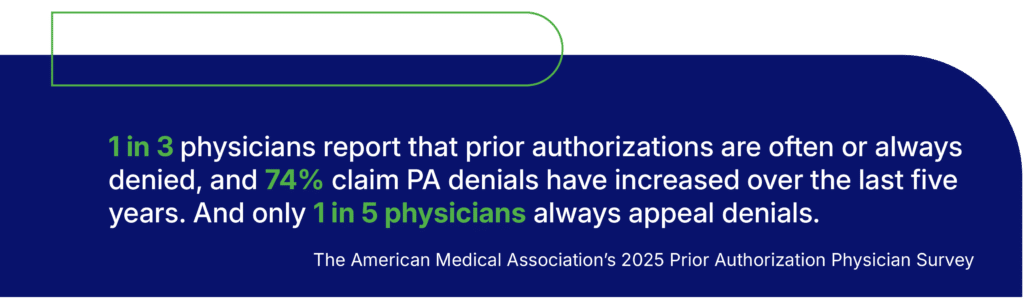
Of the four dimensions, denial prevention has the most direct line to collections. Every denied claim is revenue delayed or lost, discounted by the cost of rework. The American Medical Association’s 2025 Prior Authorization Physician Survey shows concerning trends. One in three physicians reports that prior authorizations are often or always denied, and 74% claim PA denials have increased over the last five years. And only one in five physicians always appeals denials.
That’s recoverable revenue left on the table, but it doesn’t have to be. The highest-ROI platforms stop claims from being denied instead of just helping you appeal after the fact.
Evaluate Denial Prevention as a Revenue Engine
Evaluate pre-submission editing depth, not just the presence of claim scrubbing, by asking what level of edits the platform applies before a claim leaves the system. Ask vendors for their clean-claim and first-pass acceptance rates, and confirm the platform verifies coverage before service.
Because prevention won’t catch everything, evaluate how quickly the platform helps resolve the denials that slip through. Look for denial-pattern reporting that surfaces why denials happen so you can fix the root cause instead of reworking the same claim type forever.
A practice that selects for strong denial prevention collects a higher share of what it bills and collects it faster. First-pass acceptance rises, rework hours fall, and fewer dollars age into write-offs. Just as importantly, denial-pattern visibility turns each denial into a one-time problem to solve rather than a recurring leak. This allows you to compound your collection performance over time.
The Scalability Dimension
Most practices evaluate platforms against current needs. These needs may include today’s volume, today’s payer mix, or today’s number of providers. A platform that fits perfectly today but can’t scale with you represents a poor long-term investment, because replacement costs are both expensive and disruptive.
ROI has to be calculated across the platform’s useful life against your growth trajectory. A platform that serves you for two years before forcing a replacement delivers far lower returns than one that supports five to seven years of growth, yet most practices never run that math.
Evaluate for Future-State Fit (Not Current-State Comfort)
Evaluate healthcare billing platform candidates against a projected three-to-five-year growth trajectory, not your current state. Assess for the dimensions that growth actually stresses, such as volume capacity, multi-location support, and additional payer complexity. Calculate the total cost of ownership with the replacement cost built in if the platform stalls out early and require the vendor to demonstrate performance at a scale comparable to where you expect to be.
Practices that evaluate for future-state fit make investments that compound ROI across a multi-year lifecycle instead of forcing a premature, disruptive transition. Their billing infrastructure enables growth rather than constraining it, their total-cost-of-ownership math is honest, and they sidestep the replacement costs that destroy the return on a “comfortable fit for today” decision.
Reframe Your Medical Billing Platform Decision Toward ROI, Not Features
You need a way to weigh candidates against each other and reach a defensible decision. Build a simple ROI scorecard from the framework described in this paper. Score each platform on integration, reporting, denial prevention, and scalability using the demonstrated evidence you gathered, not vendor assertions. A one-to-five scale works well, with each score anchored to something you’ve seen for yourself in a demonstration or confirmed with a reference.
Then, weigh the dimensions so they reflect your practice’s priorities. Each one is not equally important to everyone. A practice bleeding revenue to denials should weigh denial prevention most heavily. A multi-location group on a growth path should weigh scalability. A practice drowning in manual EHR re-entry should weigh integration. Apply your weights, total the scores, and only then lay the results against the total cost of ownership. A slightly more expensive platform that scores higher across weighted dimensions will almost always deliver the stronger return, and the scorecard shows you why, in terms your CFO and partners can endorse.
This is the shift that separates buyers who get the ROI they projected from those who don’t. Feature checklists feel rigorous, but they measure the wrong thing. Real ROI comes from how deeply a platform integrates, whether its reporting drives decisions, how many denials it prevents, and whether it scales with your growth.
As you evaluate medical billing software options, stop asking vendors to demo features. Start asking them to prove outcomes instead. The right platform will help you collect more revenue, more efficiently, for years. To pressure-test your scorecard and see what outcome-driven billing looks like, contact CollaborateMD by EverHealth.