You’re responsible for staff. You’re accountable for revenue. Workflow, yep, that’s you too. So, it makes sense that tackling your data challenges feels like just one more thing. Analyzing and figuring out how to leverage the immense amount of daily data your large practice generates can feel like additional administrative burden—something you don’t have time or patience for. But that data that feels too cumbersome to deal with now can become an invaluable tool used to enhance patient care and streamline your practice. The right practice management software can help you turn revenue cycle inefficiencies into opportunities for growth.
In this whitepaper, we’ll offer a roadmap to show you how leveraging data can transform your practice from reactive to proactive, all while freeing up staff to focus on patients.
This guide provides revenue cycle management( RCM) leaders with practical insights and proven strategies to leverage cloud-based RCM software for maximum operational efficiency.
Addressing the Challenges of Large Practices
From coordinating provider schedules across multiple locations to ensuring compliant billing processes and timely patient collections, the pressure to maintain smooth, efficient operations can feel relentless. That feeling is typically the result of a broken data strategy.
In this whitepaper, we’ll explore some of the challenges you face now and offer solutions for fixing them quickly and painlessly.
Key challenges that often reflect a broken data strategy:
Manual medical billing processes that lead to claim errors, delays, and denials
Claims denial rates have shown a steady increase in recent years, with providers seeing rejection rates as high as 10-15%. Manual or semi-automated billing processes are often to blame. Even minor coding errors can lead to significant claim denials.
Using a robust platform with built-in claims scrubbing and automation rules can help your team submit clean claims on the first pass and achieve a first pass acceptance rate of 99%.
Siloed systems that make it difficult to monitor key performance indicators (KPIs)
Disconnected systems result in poor adherence to KPIs, so your goals of decreasing denial rates, speeding up payment turnaround times, and unearthing revenue opportunities get lost in the confusion of systems that don’t talk to each other.
Centralized data reporting can help you integrate all your existing data on a unified platform. Using real-time dashboards, you can use the data to track financial and clinical performance across your practice, while you maximize visibility of complete patient information.
Disconnected software tools that burden staff with duplicate data entry
With office staff expected to attend to patients, phones, faxes, and doctor requests, it’s easy to see how toggling between billing, scheduling, electronic health records (EHRs), and payer systems can be overwhelming. And the result is mistakes and delays.
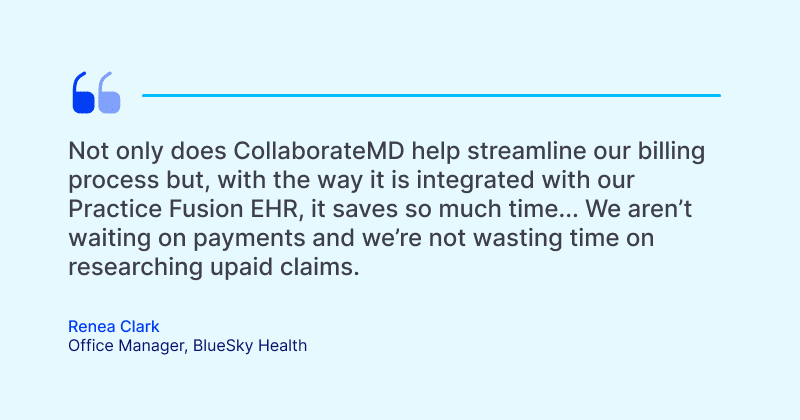
A seamless integration between Practice Management and EHR platforms, like CollaborateMD’s bi-directional integration with Practice Fusion, can eliminate redundancies and simplify training and onboarding to speed up the revenue cycle.
Limited Visibility into Performance Metrics
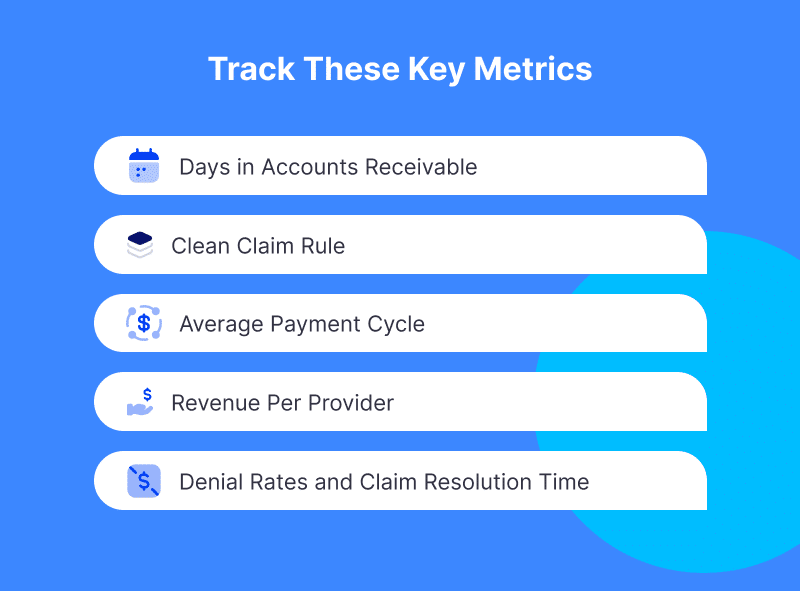
High denial rates, poor collections, long patient wait times, and aging accounts receivable are all indicators of inefficient workflows and poor visibility into your data.
Automated solutions like CollaborateMD perform eligibility checks, flag incomplete claims, and accelerate the patient intake process, which means less work, fewer denials, and faster reimbursements. And, since the system can analyze and display a vast amount of useful information in real-time, users can make better financial and patient care decisions.
Transform Your Data into Actionable Insights
Data does more than show you how you performed in the past; it has the power to help you shape the future of your practice. Data-driven software systems offer tools that convert raw data into smart strategies and are actively helping medical practices become efficient, streamlined operations that deliver effective, personalized patient care.
Improve Revenue, Efficiency, and Patient Care with CollaborateMD
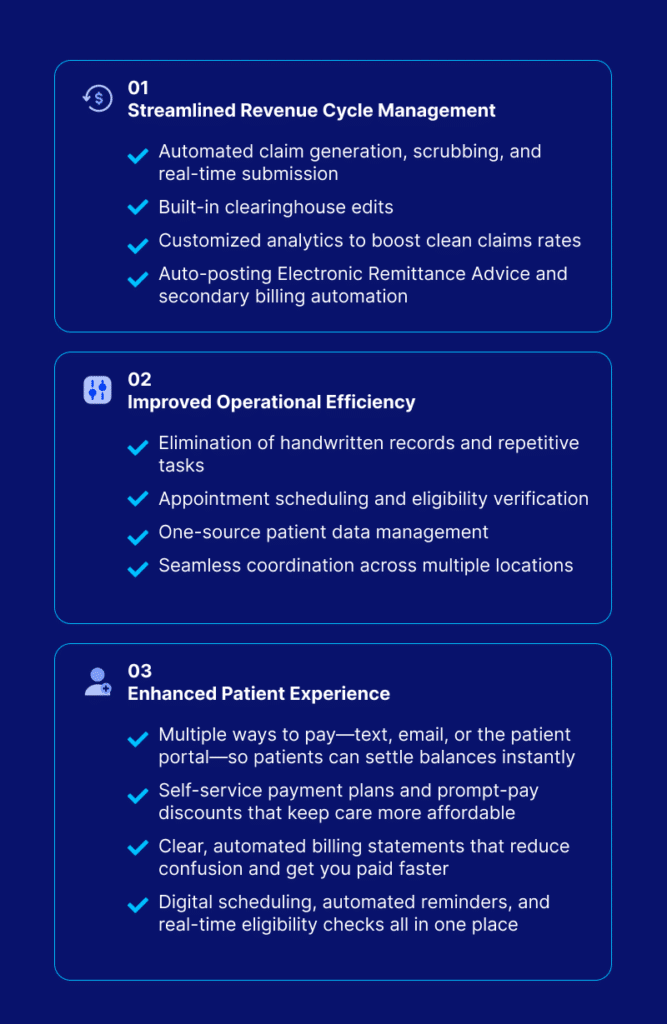
Running a medical practice should be about providing excellent patient care, not about time-consuming billing and administrative tasks. CollaborateMD provides medical practices with intake-to-payment automation and tools to efficiently manage billing and patient coordination.
Gain Efficiency
Make the most of automated workflows that streamline appointment scheduling, eligibility checks, and billing and claims processing.
Real-time dashboards and advanced financial reporting tools allow revenue cycle management teams to monitor key performance indicators and make informed decisions about operating costs to boost cash flow.
Improve Your Finances
Use tools like front-end claim scrubbing, Electronic Remittance Advice auto-posting, and built-in payer rules to optimize the revenue cycle, increase first-pass resolution rates, and reduce denials. Because CollaborateMD owns its clearinghouse, you get faster claim resolution, which cuts days from the reimbursement timeline.
Improve the Patient Care
Digital tools for scheduling, insurance verification, and patient payments make the healthcare experience more convenient from the first appointment through final payment. Online payment options, patient-directed payment plans, and prompt-pay discounts help patients manage their financial responsibility while helping practices improve collections.
Make Better, Data-driven Decisions with CollaborateMD
Choosing a practice management software is more than a technical decision; it’s a strategic investment. With CollaborateMD you’ll see:
- User-friendly interfaces that reduce training time and staff frustration
- Integration with EHR/EMR systems for seamless data exchange
- AI-powered Universal Import that connects with any EHR export to eliminate manual data mapping and deliver billing-ready claims in minutes.
- Increased office efficiency from end-to-end in front of automated workflows and reduced administrative overhead
- Improved revenue cycle from real-time eligibility checks and electronic claim submission
- Improved workflows from integrated appointment scheduling and digital patient intake
- Streamlined coding and claims scrubbing for clean claims at first submission
- Easy claims tracking to monitor the claims lifecycle in real time
- Advanced reporting and dashboards to quickly understand financial performance and monitor key performance indicators
- Improved patient care experience from better communication and convenient payment options
- Scalability and customization that grows with your practice
CMD’s Universal Import tool has proven to be a remarkable asset for our teams! Overnight, it paved a way to improving overall production with unparalleled accuracy and ease…saving us from the administrative burden of hours of manual data entry work.
Alisha Parry, Director of Revenue Cycle Management Larsen Billing Service, LLC
They have some really good dashboard charts and graphics that help you easily see how you are doing and what you need to quickly address, like rejections or errors.
Dr. Friedman Partner, Suffern Podiatry
CollaborateMD’s Real-time Insights Drive Real-time Decisions
You gain more than a medical billing platform with CollaborateMD. With real-time feedback on financial and operational health, you gain a partner that empowers enterprise-level decision making.
See how CollaborateMD can help you navigate complex medical billing workflows and maximize operational efficiency with a personalized demo.
EH-RunYourPractice-AZ-PatientChecklist