
The Importance of Efficient Laboratory Billing Software
Laboratory testing is the single highest-volume medical activity, with patients of all ages undergoing testing every single day.
Labs need to deliver accurate results while meeting regulatory requirements and maintaining financial stability. It’s not an easy feat, and laboratories must optimize their billing operations to stay ahead.
This includes investing in efficient medical billing software. Your laboratory’s financial health depends on more than just delivering quality test results. Every specimen processed, every report generated, and every service provided must translate into timely, accurate billing to sustain your operations.
When billing systems fail, the ripple effects impact every aspect of your lab—from cash flow disruptions to administrative burdens that divert your team’s attention away from patient care.
The stakes have never been higher. Regulatory requirements continue to tighten, patient expectations for transparency and improved care experiences are growing, and competition is intensifying. In this environment, your laboratory billing software isn’t just a back-office tool; it’s a strategic asset.
Throughout this guide, you’ll discover:
- What laboratory billing software really does and why it matters for your daily operations.
- The power of automated billing processes and how they accelerate your revenue cycle.
- How robust reporting and analytics can reveal opportunities to optimize your billing performance.
- How scalable features ensure your software grows with your lab’s success.
- The quick wins and long-term benefits of advanced tools for insurance verification and claims management.
- How you can create the ultimate billing experience with CollaborateMD and how its suite of features contributes to improved laboratory billing by focusing on accuracy, efficiency, and compliance.
The ideal laboratory billing solution streamlines your revenue cycle, reduces administrative overhead, and frees your team to focus on delivering exceptional patient care.
More importantly, having the right billing solution provides the financial stability and operational efficiency your lab needs to thrive and compete. Your patients will benefit from faster, more transparent billing processes, while your staff will appreciate workflows that make their jobs easier, not harder.
By the end of this guide, you’ll have the knowledge and confidence to select laboratory billing software that not only meets your current needs but positions your laboratory for sustained success in the years ahead.
The Basics of Lab Billing Software
Laboratory billing software is designed to manage the complex financial processes unique to diagnostic testing facilities. Unlike general medical billing platforms, lab billing software handles the intricacies of test codes, specimen tracking, result reporting, and multi-payer reimbursement scenarios.
Lab billing software orchestrates the entire billing lifecycle—from order entry and specimen collection through claim submission and payment posting. It manages relationships between referring physicians, patients, and multiple insurance payers while ensuring accurate coding for thousands of different tests and procedures.
By optimizing billing for lab services, these systems not only streamline the payment collection process but also ensure faster and more efficient revenue cycles for labs of all sizes.
So, what happens when your laboratory lacks the right billing software? Your team will face constant operational difficulties and roadblocks that hinder efficiency and growth, including:
Time wasted
Manual processes can lead to coding errors, delayed claim submissions, and inconsistent follow-up on denied claims. For example, without automated claims scrubbing and submission, processing and filing claims takes longer. This creates delays in reimbursement from insurers and can cause significant cash flow problems, hindering the lab’s ability to cover operating expenses.
Staff burden
Without automation, staff spend countless hours on data entry, leaving little time for revenue optimization or patient service improvements. With the staffing shortages and high turnover rates in laboratories today, this administrative burden already puts stress on an overworked staff and detracts from lab test turnaround times and other critical tasks. The U.S. Bureau of Labor Statistics projects more than 24,000 vacancies for clinical laboratory technologists—per year—over the next decade.
Revenue loss
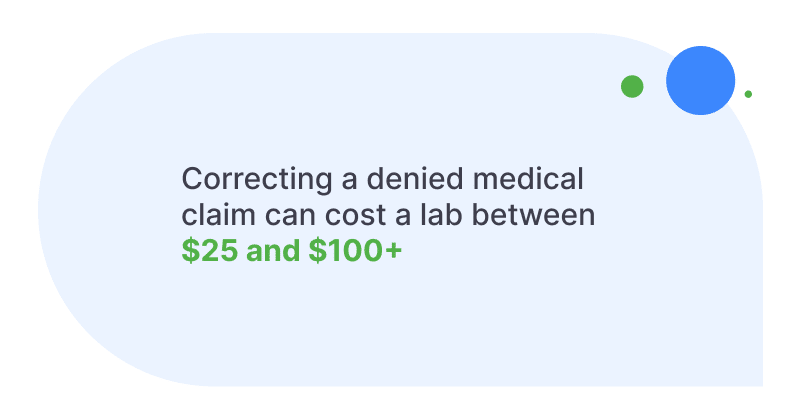
Manual billing processes often lead to higher claim denials compared to automated systems. These denials require additional staff time to research, correct, and resubmit—creating a cycle of inefficiency that drains profitability.
Digitizing billing processes deliver measurable benefits. Automated systems improve accuracy by eliminating transcription errors and ensuring consistent coding practices. They also revive payment cycles by submitting claims within hours rather than weeks. Most importantly, they provide real-time visibility into financial performance, enabling proactive management of revenue cycle metrics.
Seamless Integration for Enhanced Efficiency
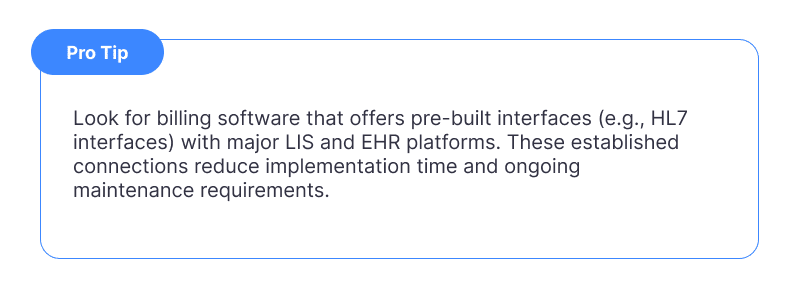
Modern laboratories operate within complex technology systems. To navigate this maze, your billing software must integrate seamlessly with Laboratory Information Systems (LIS) and Electronic Health Records (EHRs) to eliminate data silos and reduce manual intervention.
LIS Integration
LIS integration is particularly critical for laboratory billing and must be nothing less than free flowing. When your billing system connects directly to your LIS, test results, patient demographics, and ordering provider information transfer automatically between systems. This eliminates the need for dual data entry and ensures billing accuracy from the moment specimens are processed.
EHR Integration
EHR integration creates similar efficiencies for laboratories. Patient information, insurance details, and clinical data synchronize between systems, reducing registration errors and improving claim accuracy. When physicians order tests through the EHR, the information flows directly to your billing system, provided that proper authorization and medical documentation are in place.
These integrations deliver tangible benefits, including:
- Reducing duplicate data entry
- Minimizing transcription errors that lead to claim denials
- Creating audit trails that demonstrate compliance with documentation requirements
Integrated systems also enhance claim processing speed. Instead of waiting for manual data entry and verification, claims can be generated and submitted within hours of test completion. This speed directly impacts cash flow, reducing time in accounts receivable.
Automating the Laboratory Billing Process
One of the biggest questions on the minds of most lab billing managers is, “What slows down our revenue cycle?” The standout issues that delay this process include:
- Insurance verification
- Outdated information
- Coding issues
- Manual data entry errors
- Lack of review process
Automation represents the single most impactful software feature that can address these challenges. By automating claim submission, coding, charge capture, and payment posting, labs can dramatically reduce processing time and potential errors while improving accuracy and cash flow.
Charge capture
Automated charge capture ensures that every billable test is captured and coded correctly. The system monitors test orders and results, automatically generating charges based on predefined fee schedules and coding rules. This eliminates the revenue leakage that occurs when manual processes fail to capture billable services.
Claim submission
This tool eliminates the delays associated with manual claim preparation and submission. The system can submit claims electronically within hours of test completion, often while results are still being reviewed.
Payment posting
This automation handles the labor-intensive chore of applying payments to patient accounts. Electronic remittance advice (ERA) data is automatically processed, with payments posted to the correct accounts and adjustments made in agreement with contract terms. This reduces processing time from hours to minutes per payment batch.
Coding
Automatic coding applies the appropriate CPT, HCPCS, and ICD-10 codes based on test types and clinical indications. Advanced systems ensure medical necessity requirements are met and that codes align with payer-specific requirements.
The error reduction benefits of automation are equally significant. Automated systems eliminate transcription errors, ensure consistent coding practices, and catch potential issues before claims are submitted.
AI-Driven Integration and Scalability
Laboratory billing operates at a different level of complexity than standard medical billing. High test volumes, intricate coding requirements, strict payer rules, and the need for continuous data exchange between systems require software that can automate workflows and scale efficiently as operations grow.
Modern medical billing platforms increasingly use AI-driven automation to help laboratories manage these demands. By reducing manual processes and improving data accuracy, these tools help labs streamline operations, accelerate reimbursement, and support long-term growth.
Using AI to Automate Medical Billing Workflows
Automation is one of the most valuable capabilities in laboratory billing software. By handling repetitive tasks throughout the revenue cycle, automated systems allow billing teams to spend less time on administrative work and more time resolving exceptions and improving financial performance.
AI-Assisted Data Import
Laboratories frequently exchange data with external providers, EHRs, and laboratory systems that may use different formats and standards.
Importing this information manually often requires extensive mapping and data validation.
AI-assisted import tools help simplify this process by mapping encounter data from formats such as HL7, ANSI837, CSV, and Excel files. These systems can identify missing or inconsistent information before import and help convert source data into billing-ready claims more efficiently.
For example, CollaborateMD offers an AI-powered Universal Import tool to automate data mapping of patient and claims when direct integrations are unavailable. This can reduce manual data entry and shorten onboarding timelines.
Automated Coding and Claim Submission
Manual coding remains one of the most common causes of claim denials. Advanced billing systems can automatically apply the appropriate CPT, HCPCS, and ICD-10 codes based on test types and clinical indications while validating medical necessity requirements and payer-specific rules.
Automated workflows help improve coding consistency, reduce transcription errors, and accelerate claim submission. Rather than waiting days or weeks for manual processing, claims can often be submitted electronically within hours of test completion.
Integration Capabilities That Eliminate Data Silos
To support efficient laboratory billing, software should integrate seamlessly with both Laboratory Information Systems (LIS) and Electronic Health Records (EHRs). When systems communicate effectively, critical information flows automatically between clinical and financial workflows, reducing duplicate data entry and improving billing accuracy.
LIS integration allows test results, patient demographics, and ordering provider information to transfer directly into billing workflows. EHR integration provides similar efficiencies by synchronizing patient and insurance information, reducing registration errors and improving claim accuracy.
A connected technology ecosystem helps laboratories:
- Reduce duplicate data entry and administrative workload
- Minimize transcription errors that can lead to denials
- Improve charge capture and claim generation speed
- Maintain better visibility across clinical and financial operations
- Support compliance through more complete and consistent documentation
When evaluating lab billing software vendors, look for solutions that offer direct integration with leading LIS and EHR platforms. For organizations that rely on legacy systems or custom workflows, flexible import capabilities can provide an effective alternative when direct API integrations are unavailable.
Building for Future Growth
As laboratories expand services, increase test volumes, or add locations, billing software must be able to support growth without creating operational bottlenecks.
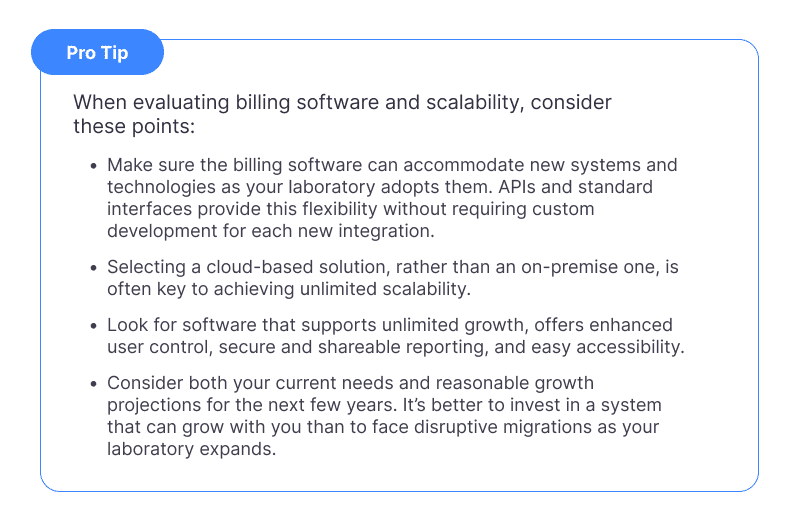
Scalable billing platforms are designed to accommodate increasing claim volumes, additional users, and evolving workflows while maintaining performance and visibility. Cloud-based solutions are particularly well-suited for growth because they provide flexibility without requiring costly infrastructure upgrades or system migrations.
When evaluating scalability, consider whether a platform can:
- Support increasing claim and transaction volumes
- Provide visibility across multiple locations or business units
- Accommodate additional users without performance degradation
- Adapt to changing workflows and payer requirements
- Integrate with new technologies as operational needs evolve
The right medical billing platform should not only support your laboratory’s current needs but also provide the flexibility to grow alongside your organization. Investing in scalable technology today can help avoid disruptive transitions and unnecessary costs in the future.
Ensuring Data Protection and Regulatory Compliance
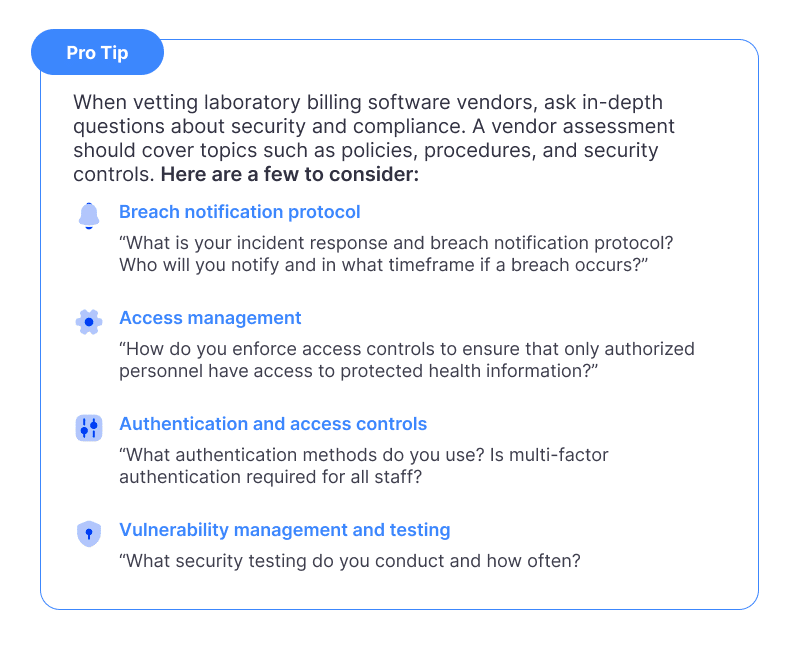
Lab billing software handles some of the most sensitive information in your organization. With this understanding, HIPAA compliance isn’t optional—it’s fundamental to protecting both your laboratory and your patients while avoiding costly violations.
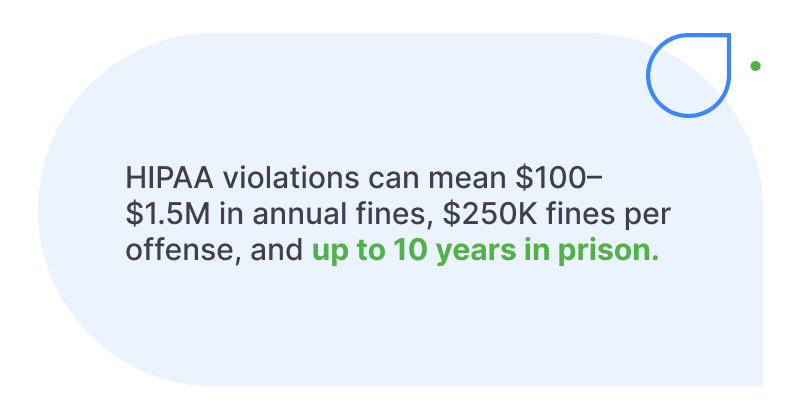
To avoid these penalties, maintaining compliance requires many technical and administrative safeguards. Here are a few key billing software safety features to know:
Access controls: Your laboratory billing software must implement access controls that limit user access to only the information necessary for their job functions.
Audit logs: This tool tracks all system access and data modifications, creating a comprehensive record of who accessed what information and when.
Data encryption: This feature protects information both at rest and in transit. Look for systems that use an encrypted 256-bit SSL connection and TLS 1.2 or higher for data transmission. These industry-standard encryption methods ensure that patient information remains protected even if it is compromised.
Multi-factor authentication: This is a security method that requires a user to provide at least two different forms of verification to gain access to a system.
Regular security updates: This patches known vulnerabilities and addresses emerging threats.
Audit trails serve multiple purposes beyond compliance and can help reduce risks.
Not only do audit trails help track billing activities and provide documentation for revenue cycle analysis, but they also pinpoint unusual patterns that might indicate errors or fraud. When claims are denied or payments are delayed, audit trails also help identify the root cause quickly and implement necessary corrections, giving your lab peace of mind.
Leveraging Data-Driven Insights
Data without insights is just a bunch of numbers and graphs. Effective laboratory billing software transforms raw billing data into actionable insights that drive revenue optimization and operational efficiency.
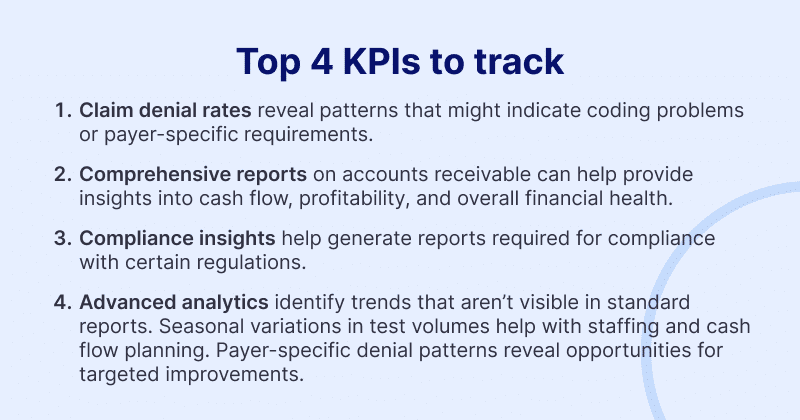
Customizable reporting capabilities enable you to create dashboards tailored to your team’s specific needs. Scenarios include:
- Financial managers need cash flow projections and reports.
- Billing teams benefit from productivity metrics and error rate analysis.
- Laboratory managers may want revenue per test type and payer mix analysis.
Data-driven insights and reports provide key performance indicators (KPIs) that offer measurable benchmarks for areas such as billing performance, revenue by payer and test type, and accounts receivable, helping you collect more money.
Real-time reporting also enables proactive management of revenue cycle issues. Instead of discovering problems weeks later in monthly reports, billing teams can identify and address issues immediately. This responsiveness can reduce the length of the revenue cycle.
Predictive analytics takes reporting further by forecasting future performance based on historical trends. These insights help with budgeting, staffing decisions, and strategic planning. They can also identify potential cash flow challenges before they impact operations.
Building a Scalable Billing Solution
Your laboratory won’t remain static. Test volumes will fluctuate, new locations may open, and additional services will be added. Your lab billing software must accommodate this growth without requiring expensive system replacements.
User increase
The number of users who can access your software represents the most basic scalability requirement. Can the system support additional billing staff without performance issues? How easily can new users be added and configured? Look for software that offers flexible options that align with your growth patterns rather than forcing large upfront commitments.
Data volume
Data volume management becomes critical as test volumes grow. Your lab billing software must handle increasing claim volumes without slowing down. Database architecture and server infrastructure should scale seamlessly as your laboratory processes more tests and generates an increasing number of claims.
Modular features in billing software provide growth flexibility by allowing you to add capabilities as needed. For example, a per-transaction pricing module will keep costs down as you attract more clients. Features such as electronic claims and patient eligibility verification pricing would be volume based. This approach spreads costs over time while ensuring you only pay for features you actually use.
Enhancing User Experience
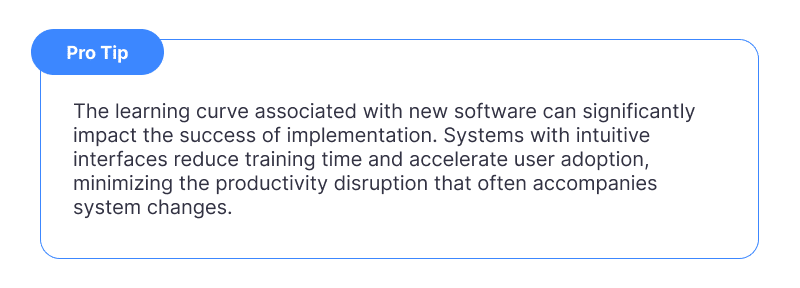
Even the most feature-rich billing software fails if your staff can’t use it. An intuitive, user-friendly interface directly impacts productivity, error rates, and user adoption. Here’s how:
Well-designed systems require minimal clicks to complete basic tasks. For example, streamlined navigation reduces the time staff spend searching for features and information.
Customizable dashboards let different users configure their workspace based on their specific responsibilities. For example, billing specialists might prioritize denial management tools. Supervisors may need productivity metrics and staff performance indicators. Financial managers may require cash flow summaries and collection statistics.
In-system guidance helps new users learn the software while providing ongoing support for experienced users tackling unfamiliar tasks. Context-sensitive help and intelligent prompts reduce training requirements and minimize errors.
Managing the Claims Lifecycle
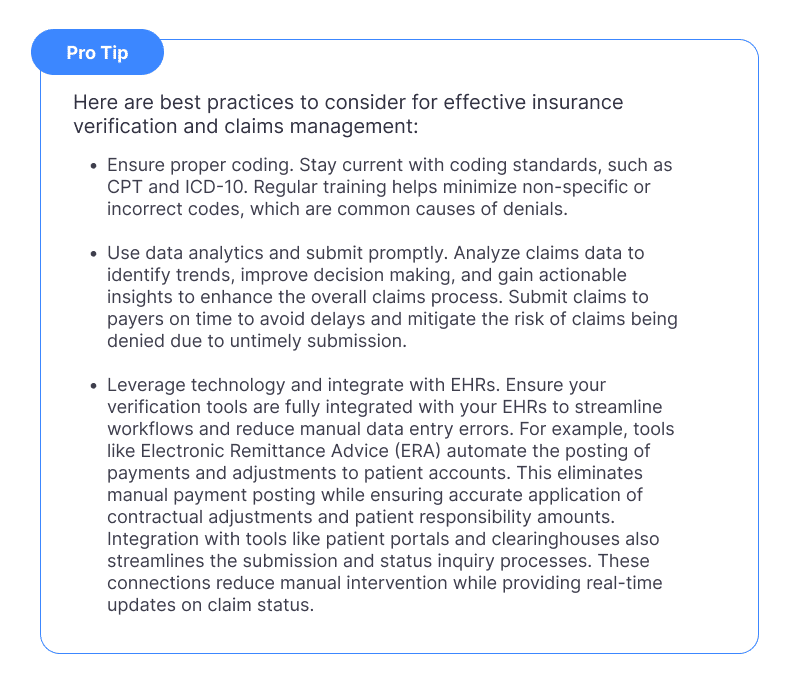
Insurance verification and claims management represent core functions that directly impact your laboratory’s revenue cycle. Effective lab billing software automates these processes while providing tools for proactive management of denied claims. Here’s how:
Real-time verification
Features such as real-time eligibility verification prevent many billing issues before they occur. By verifying patient insurance coverage and benefits at the time of service, labs can identify coverage limitations, authorization requirements, and patient responsibility amounts. This upfront verification reduces claim denials and improves patient satisfaction by eliminating surprise bills.
Claims scrubbing
Claim scrubbing identifies potential issues before claims are submitted to payers.
Automated edits check for common errors like missing information, invalid codes, and inconsistencies. This proactive approach reduces denial rates and accelerates payment by ensuring claims are processed correctly on the first submission.
Denial management
Denial management tools help track and resolve denied claims systematically. Effective systems categorize denials by reason, track resolution progress, and provide workflow tools for addressing different types of issues. This systematic approach ensures that denied claims receive the right follow up and are not overlooked.
Claims tracking
Claims tracking provides visibility into the status of submitted claims throughout the adjudication process. Real-time status updates help identify claims that require follow-up attention. Aging reports highlight claims that are approaching the filing limit or require additional action. With claim tracking in real time, laboratory system users are able to nudge payers on claims that seem to be collecting dust.
Improving Patient Satisfaction
Patients today expect easy online access to their health information, including billing statements and test results. Patient portals are essential
for meeting these expectations while also encouraging patient engagement and enhancing administrative efficiency.
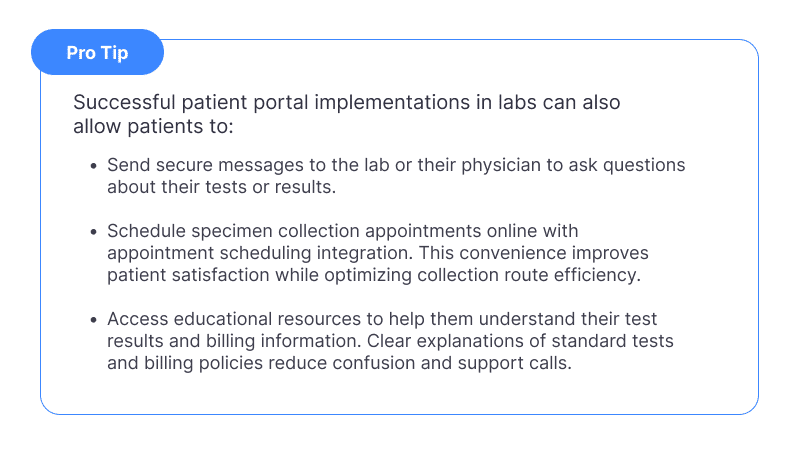
- Online bill access reduces administrative workload while improving patient satisfaction. Patients can view current balances, payment history, and detailed billing information at their convenience. This self-service capability reduces phone calls to your billing department while providing transparency that patients really appreciate.
- Patient portals offer secure messaging, allowing patients to ask billing questions and receive responses without having to play phone tag. This improves communication efficiency while maintaining HIPAA compliance through secure channels.
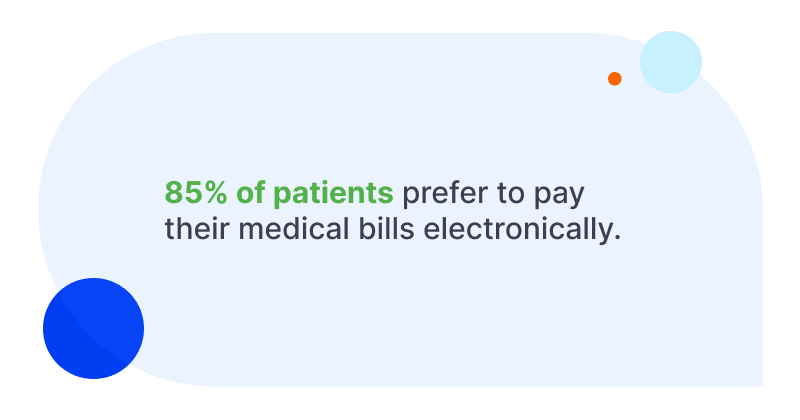
Patients often prefer to pay bills electronically because payment processing capabilities within portals let them pay bills online using credit cards, debit cards, or ACH transfers.
For laboratories, online payments accelerate cash flow while reducing processing costs compared to paper checks. Payment plan options also help patients manage larger balances while ensuring consistent revenue flow.
Patients also prefer instant online access to their test results.
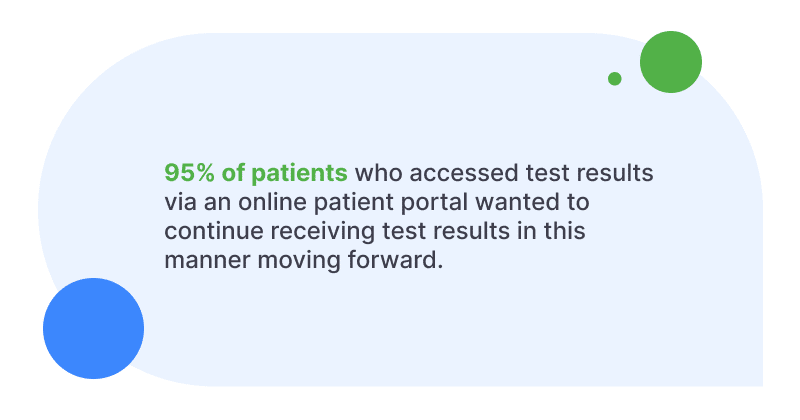
Researchers at Beth Israel Deaconess Medical Center also found that patients who accessed their test results online overwhelmingly supported receiving the results immediately, even if their provider had not yet reviewed them.
Test result access through patient portals also eliminates many routine phone calls and provides patients with immediate access to their information. Patient portal integration with your LIS ensures that results are available as soon as they’re approved by laboratory staff.
Ensuring Smooth Implementation and Ongoing Success
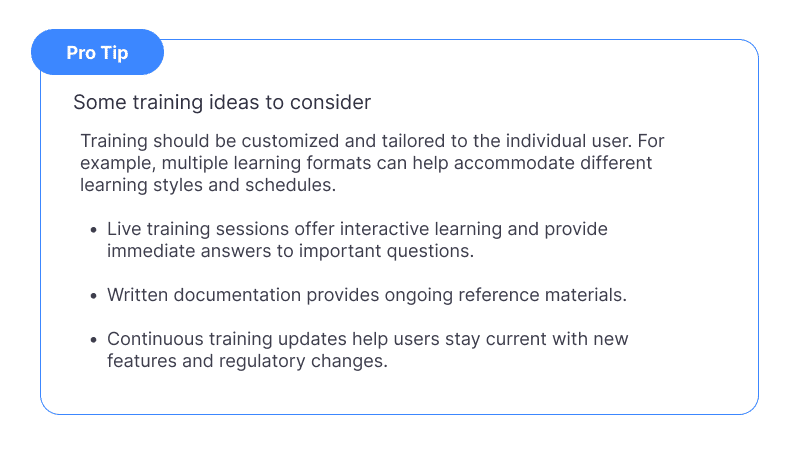
The quality of customer support and training can make or break your billing software implementation. Even the best software becomes an issue if users can’t get help when they need it or aren’t properly trained on system capabilities.
Onboarding assistance helps ensure successful implementation from the start. Make sure your lab billing software vendor offers experienced implementation specialists who understand common roadblocks and can guide your team through setup, configuration, and initial training. This support reduces implementation time while minimizing disruption to ongoing operations.
Regular training sessions, updated documentation, and feature announcements ensure that your investment in the software continues to deliver value as capabilities expand.
Choosing a Vendor
Ready to begin searching for the right billing software vendor, but not sure where to start? Here are some critical questions and tips to consider when evaluating vendor quality:
- Does the vendor have quality metrics to show their performance? Average response times, first-call resolution rates, and customer satisfaction scores indicate the level of service you can expect. Look for vendors that publish these metrics and demonstrate consistent performance over time.
- Do they offer a dedicated manager? Dedicated account management provides personalized support for larger laboratories. Account managers understand your specific environment and can provide proactive guidance on optimization opportunities and best practices.
- What are your needs? Consider both the vendor’s capabilities and your internal support needs. Smaller labs benefit from comprehensive vendor support, while larger organizations prefer more self-service options with targeted expert assistance.
- What are the vendor’s support and training services like? Make sure the vendor provides dedicated training, a support and knowledge center, and an implementation specialist during onboarding. With dedicated support, switching is simple and perfect for laboratories managing multiple practices with diverse needs.
Create the Ultimate Billing Experience with CollaborateMD
At CollaborateMD, we understand that you need a reliable solution to streamline laboratory billing operations and help grow your business. We know the billing process can be complicated and inefficient, which can make you feel stuck and overwhelmed.
CollaborateMD is a powerful billing software platform that can handle the volume and complexity of your billing operations, ensure compliance, provide valuable financial insights, and seamlessly integrate with your existing laboratory systems. We offer a suite of features that contribute to improved laboratory billing by focusing on accuracy, efficiency, and compliance. Key features include:
Accuracy and Error Reduction
- Claim Scrubbing: Employs Level 2 claim edits, including CCI, NCD/LCD, LMRP, and modifier checks to identify and correct potential coding errors before claims are submitted, significantly reducing the denial rate.
- Built-in Clearinghouse and Claim Edits: Provides thousands of clearinghouse and payer edits, helping prevent errors and rejections.
- Real-time Eligibility Verification: Allows labs to verify patient insurance eligibility promptly, ensuring claims are filed with accurate information and reducing the risk of denied claims due to coverage issues.
- Warning Messages for Coding Errors: Presents warning messages to help prevent potential coding errors and allows users to address rejected claims before sending them to payers.
- Default Procedure and Measurement Codes: Support for grams, mgs, and units of measurement to ensure accuracy in every claim.
Workflow Automation and Efficiency
- Automated Charge Capture: Streamlines the process of capturing charges, using an integrated app to manage patient notes, billing codes, and rounding lists, reducing the likelihood of lost or missed charges.
- Electronic Claim Submission: Enables quick and efficient submission of claims, allowing labs to know whether claims have been accepted and are on their way to the payer in real time.
- Electronic Remittance Advice (ERA) with Auto Posting: Eliminates paper EOBs and provides digital claim payment information, accelerating payment collection and simplifying reconciliation of patient and insurance payments.
- Claim Follow-up and Task Management: Provides tools to track submission timelines, follow up on priority claims, and manage tasks, thereby minimizing the risk of missed deadlines and enhancing productivity.
- Integration with EHR/EMR Systems: Seamlessly integrates with EHR systems, streamlining the flow of patient and billing data and minimizing duplicate data entry.
- Automated Patient Statements and Payments: Generates and sends patient statements automatically (including options for discounts and payment plans), offering online payment options and reducing administrative burden.
Reporting and Analytics
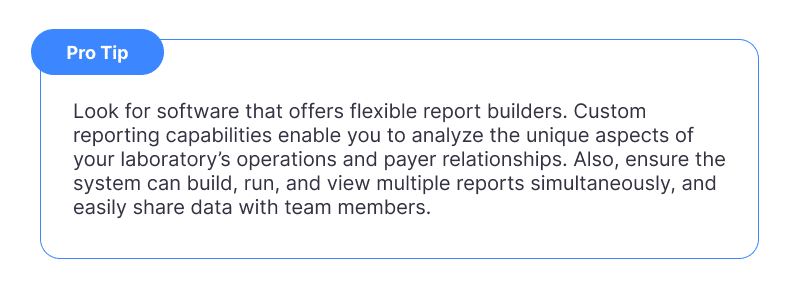
- Advanced Dashboard Reporting and Analytics: Provides a clear picture of business operations with more than 125 customizable reports and the ability to build, run, and view multiple reports concurrently, facilitating data dissemination and analysis.
By offering these features, CollaborateMD aims to enhance the overall efficiency of your laboratory billing operations, reduce claim denials and rejections, improve cash flow, and ensure timely reimbursements, allowing you to focus on your core mission of providing quality patient care.
Remember that choosing laboratory billing software isn’t just a technical decision—it’s a strategic investment in your laboratory’s future. Take time to evaluate your specific needs, involve key stakeholders in the selection process, and prioritize vendors that demonstrate commitment to ongoing support and development.
The features outlined in this guide provide a framework for evaluation; however, your specific requirements will determine which capabilities are most important. Start with integration requirements and compliance needs, then layer on automation, analytics, and user experience features that align with your operational goals.
With the right billing software in place, your laboratory can focus on what it does best: delivering accurate, timely diagnostic services that support better patient care while maintaining the financial health necessary for long-term success.
Interested in how you can create the ultimate billing experience with CollaborateMD?
View a quick demo of our billing software to see how it can help your lab obtain every dollar for every test!