Streamlined medical billing processes, financial transparency, and seamless integration are paramount for successful billing management and, in particular, revenue cycle management (RCM).
Medical billing company leaders today are managing more complexity than ever—rising denial rates, expanding client rosters, constant payer rule changes, and growing pressure to deliver financial transparency across every account. The billing companies pulling ahead aren’t necessarily working harder. They’re using smarter technology. This guide breaks down exactly what that looks like in practice.
The Advantages of Cloud-based Revenue Cycle Management (RCM) Technology
We know that to be a trusted leader in the medical billing industry, you need a reliable solution to streamline operations and help grow your business. The problem is that the billing process is complicated and inefficient – often made more so by unhelpful technology.
If you’re thinking medical billing shouldn’t be this hard, you’re right. Cloud-based RCM platforms help medical billing company leaders modernize their operations. From enhanced accessibility to automated updates, cloud RCM technology provides unparalleled advantages over traditional, on-premises systems.
Four Key Strategic Benefits of Cloud RCM
Real-time Access
Cloud platforms allow authorized users to access billing data from any device with an internet connection. This allows for greater collaboration and boosts productivity. Cloud-based platforms provide your clients with real-time claim submission and eligibility data for quicker reimbursements, allow you to manage multiple clients with ease, and provide stakeholders simultaneous access to the most up-to-date information for quicker adjudication and improved efficiency.
For medical billing companies managing dozens of client accounts, this means your team can monitor claim status, respond to client questions, and manage denial queues without being tethered to a single office or system.
Reduced IT Burden
Updates and maintenance are handled by the cloud provider, which means your IT staff can focus on strategic initiatives and other important tasks. With fewer resources spent on upkeep, you eliminate unpredictable maintenance costs and free your team to focus on what actually generates revenue—client service, new account acquisition, and billing performance.
Enhanced Data Security
Built-in encryption and multi-factor authentication protect sensitive financial and patient data. Strengthened security safeguards your organization from data breaches and compliance violations, building trust with clients and helping you maintain regulatory standards. Look for built-in address verification that confirms USPS compliance, ensuring patient payment communications are both deliverable and HIPAA-compliant.
Scalability
The most transformative shift in modern cloud RCM isn’t storage or remote access—it’s intelligence. AI features like Universal Import automatically map and normalize encounter data from any EHR export, cutting data onboarding time by up to 90%. Built-in claim scrubbing uses automated editing rules to catch errors before submission. ERA auto-posting eliminates manual payment entry entirely. These aren’t incremental improvements; they change the math on how many clients a billing team can competently manage.
Integration Success: Best Practices for Seamless Electronic Health Record (EHR) Integration
Integrating RCM platforms with EHR systems is essential for streamlined workflows and data accuracy. CollaborateMD features robust integration capabilities that make it easy to connect with EHRs, labs, hospitals, and other third-party applications through HL7 interfaces.
This also makes data moves simple, reduces data entry duplication, and supports clinical documentation workflows for any customer.
Best Practices for Integrating RCM platforms with EHRs
Select a Platform with Proven Integration Capabilities
Look for standard and custom HL7 interfaces, which will be compatible with most EHR platforms.
Prioritize Real-Time Data Exchange
Reduce errors and delays by ensuring the data flow between systems is seamless and performed in real time. CollaborateMD’s bi-directional interface with Practice Fusion, for example, means new appointments, patient data, and superbills flow automatically into CollaborateMD—and updates flow back to Practice Fusion in real time. No double entry, no version conflicts, and no lag.
Leverage Dedicated Support
To make the transition as easy as possible, look for options that offer dedicated support. For example, CollaborateMD training specialists guide your team through every phase of integration for smooth implementation and continue to assist you during the transition as needed. The feature-rich Knowledge Center is a helpful resource that offers quick explanations, tutorials, troubleshooting, and webinars for enhanced client education.
Automated Workflows: Streamline Claims Processes and Reconciliation
Successful revenue cycle management requires streamlined claim processing and efficient reconciliation. Automation supports this need through strategic, innovative workflows that eliminate manual steps and reduce the chance of human error, optimizing both speed and accuracy.
Key Features of Effective Claim Processing with Cloud RCM
Real-time Claim Submission and Tracking
Submit claims instantly and monitor their status from start to finish so you’re never left guessing. Real-time tracking empowers your team to proactively manage claim issues, provide clients with accurate updates, and reduce the time it takes to get paid.
Advanced Claim Scrubbing
Detect errors early and address them before submission to avoid rejections, save time, reduce rework, and boost your clean claim rate. Plus, fewer rejections mean faster payments and happier clients.
Payment Posting and Reconciliation
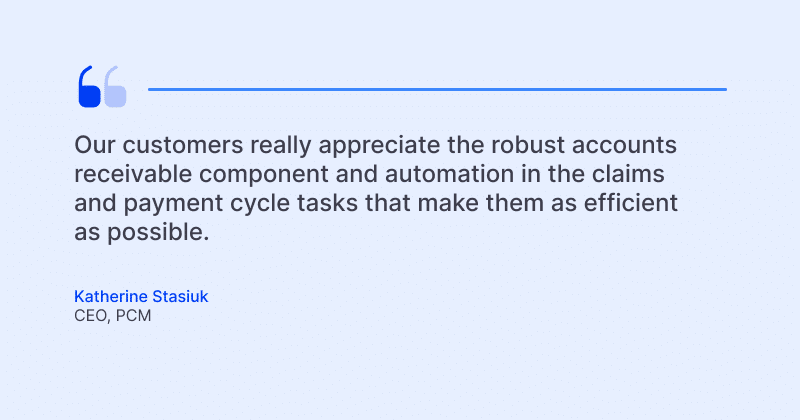
Simplify reconciliation with integrated Electronic Remittance Advice (ERA) auto-posting and payment portals that eliminate manual data entry. This speeds up your revenue cycle, reduces costly human errors, and allows your team to stop worrying about losing revenue and focus on providing high-quality services to attract new clients and grow your business.
AI-Powered Data Import
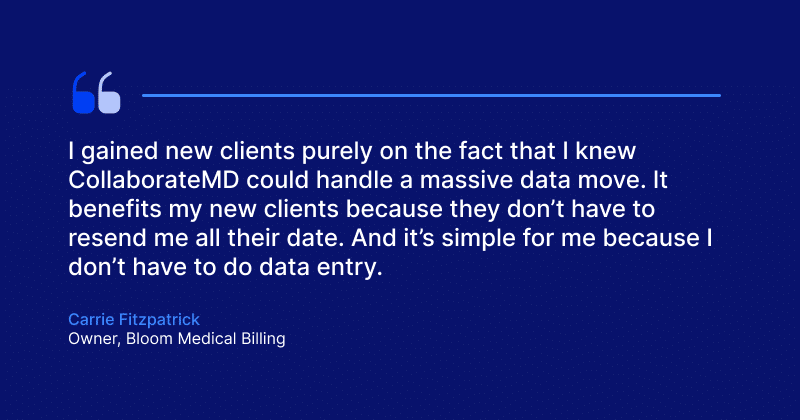
For medical billing companies onboarding new clients, importing new encounter data has traditionally been one of the most time-consuming steps. CollaborateMD’s Universal Import eliminates that bottleneck. Using AI software to automatically map data from any EHR export, it transforms raw files into billing-ready claims in minutes, without manual intervention, specialist involvement, or IT support. Import templates can be saved and reused across multiple client accounts, making each subsequent onboarding faster than the last.
Financial Visibility: Advanced Reporting for Better Financial Oversight
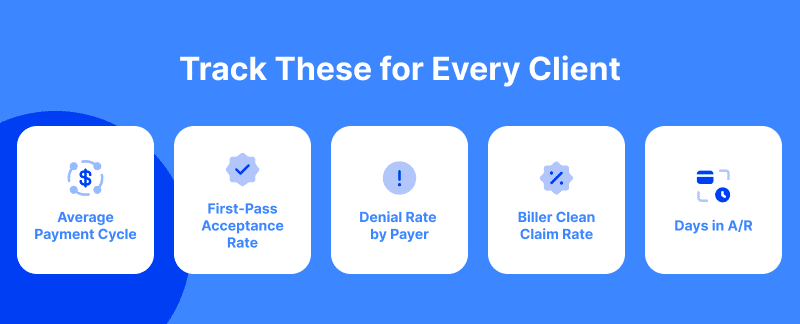
Financial transparency is critical for managing revenue effectively. If you’re unsure about your revenue streams and trying to manually pull insights to help you figure it out, you’re wasting precious time. The advanced reporting features of the best cloud RCM platforms deliver insights on biller performance and individual clients. Customizable dashboards and real-time KPI tracking allow users to gain immediate comprehensive visibility into financial performance.
Key Reporting Capabilities to Look for in an RCM Platform
Custom KPI Dashboards
Programmable dashboards that highlight only the key metrics and trends needed for the given task, without confusion or excess. CollaborateMD’s programmable dashboards can be configured by client, by provider, by payer, or by biller, so your team can clearly see what’s relevant. Clients can access their own dashboards directly, giving them the financial transparency they increasingly expect and reducing the inbound reporting requests your team fields.
Real-time Data Accuracy
Dynamic reporting provides up-to-the-minute information. In a fast-moving revenue cycle, a 24-hour reporting lag can mean the difference between catching a coding issue today and losing months of revenue before it surfaces. CollaborateMD’s dynamic reporting reflects current claim status, payment activity, and A/R movement. This way, your team acts on real numbers, not yesterday’s estimates.
Actionable Insights
Identifying revenue trends and financial bottlenecks means going beyond summary dashboards into drill-down analysis of denial patterns by payer, rework rates by CPT code, biller performance over time, and A/R aging by client. CollaborateMD’s reporting tools provide exactly that depth.
Cloud RCM: Maximize Operational Efficiency and Financial Transparency
Maximizing operational efficiency and financial transparency with a cloud RCM platform is more than just a financial decision, it’s essential for strategically scaling modern billing operations and critical to you maintaining your place as a trusted industry leader.
With CollaborateMD, organizations can confidently manage client accounts, streamline workflows, and gain deeper financial insights.
The technology advantage in medical billing is no longer theoretical. AI-powered automation, seamless EHR integration, and real-time financial visibility are the operational foundation that allows billing companies to take on more clients, retain them longer, and compete for accounts that previously required a larger team to service. With CollaborateMD, those capabilities are built in, not bolted on.
If you’re ready to take the next step toward streamlining operations and generating more revenue for you and your clients, CollaborateMD is ready to show you our solution in action.