
Medical billing accuracy alone no longer determines patient collections. As patients shoulder more of their own healthcare costs, collection performance depends increasingly on the payment experience itself.
Behavioral research published in Learning and Instruction shows that people consistently delay action when a task feels confusing, effortful, or uncertain, even when they fully intend to complete it. That finding is more useful than it might first appear. It means that when patients don’t pay, the cause is often predictable: not financial hardship, not indifference, but friction. And friction is something practices can actually fix.
When patients can’t tell what they owe, run into inconvenient payment options, or never get a timely prompt, they tend to put off the decision. These delays usually have less to do with unwillingness to pay than friction in the payment journey itself.
Moreover, patients expect healthcare payments to be as easy as other everyday purchases. They’re accustomed to fast, intuitive mobile payment experiences. Against that standard, confusing healthcare billing statements or outdated payment processes create noticeable friction. That gap between wanting to pay and actually being able to is where a lot of revenue gets stuck.
This guide uses behavioral psychology as its interpretive frame, examining why patients delay payment, where friction appears across statements, payment channels, and timing, and what practices can do to remove it.
As patient financial responsibility grows, the patient experience has become a revenue strategy rather than simply a back-office function. Reducing friction can accelerate collections, improve patient satisfaction, and create more predictable financial outcomes.
The Growing Importance of Patient Payment Experience
Patient collections now represent a meaningful share of healthcare revenue. According to the Centers for Medicare and Medicaid Services (CMS), in 2024, U.S. out-of-pocket healthcare spending grew 5.9% to $556.6 billion, accounting for 11% of total national health expenditures.
The longer-term trend also points to greater patient financial responsibility. In a 2025 KFF paper, 88% of covered workers were enrolled in a health plan with a general annual deductible, compared with 81% in 2015. Among workers with a deductible, the average deductible for single coverage increased 43% over the same period, from $1,320 to $1,886.
As a greater share of healthcare costs reaches patients directly, more revenue depends on an individual patient’s ability to understand a balance, engage with the billing process, and complete payment. For practices, that means collection performance is no longer determined solely in the medical billing department. It’s shaped at every point in the patient’s payment experience—from the moment a statement arrives to the moment a payment clears.
Confusing Statements Delay Patient Payment Decisions
Confusion around healthcare costs can directly affect payment behavior. According to a study published in the Journal of Patient Experience, patients are often left confused and frustrated trying to understand their healthcare bills. They might not be able to identify what part of the bill is their responsibility or even why they’re getting a bill in the first place. In 2021, 87% of consumers said they received an unexpected medical bill.
Additionally, most healthcare statements weren’t built for patients to read; they were built as an output of a medical billing system, and it shows. There might be insurance jargon, adjustment codes, three different balance numbers on one page, or charges split across lines that don’t obviously connect.
This confusion creates a significant barrier to payment. Research published in JAMA Health Forum found that only about six in 10 people with concerns about a medical bill contacted their provider for clarification. Nearly three-quarters of those who reached out because they suspected an error ultimately had the charge corrected.
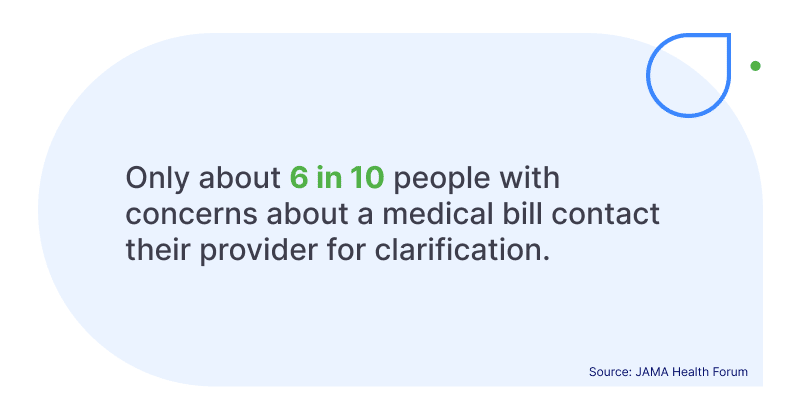
The findings suggest that medical billing concerns frequently go unresolved, delaying patient action and contributing to payment inertia.
The problem is rarely unwillingness to pay. Patients postpone payment because they lack confidence in the information in the statement. Rather than risk paying an amount they don’t fully understand, they set the statement aside, hoping to revisit it later.
What begins as a brief postponement, set aside until they can figure it out, can quietly become weeks or months of unresolved balance aging.
Designing Statements Around Patient Comprehension
The fix is building statements around what a patient needs to understand, not what the medical billing system needs.
Effective patient statements answer three questions immediately: What do I owe? Why do I owe it? How can I pay? When patients must interpret insurance terminology, adjustment codes, or multiple balance figures before finding these answers, uncertainty can delay action.
Several design principles can improve clarity and encourage faster payment decisions:
- Use plain language instead of industry or insurance jargon.
- Highlight the patient’s balance prominently and minimize competing figures.
- Organize information using a clear visual hierarchy so key details are easy to find.
- Include concise explanations of charges and insurance adjustments.
- Make payment options highly visible and easy to access through QR codes, payment links, digital wallet payment options, or online patient portals..
When patients can immediately understand their financial responsibility and next steps, they are more likely to act with confidence. The result is fewer billing inquiries, faster payments, and a more efficient collection process.
Mobile-First Payment Expectations Are Changing Patient Behavior
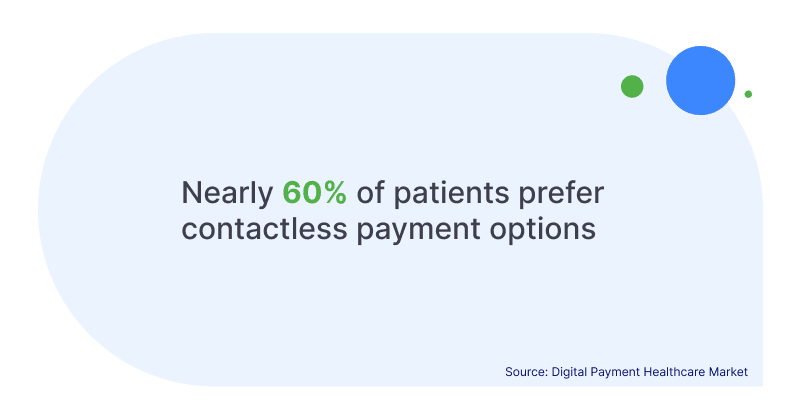
According to the Digital Payments Healthcare Market, patients are increasingly using their smartphones to manage their healthcare payments. Nearly 60% of patients say they’d rather pay with a contactless method, such as a contactless card or mobile wallet.
As mobile payment habits become more established, patients increasingly expect healthcare payment experiences to offer the same level of simplicity and convenience.
Yet many practices continue to rely on payment processes that aren’t preferred by patients, such as paper checks, phone payments, or portals that require multiple steps before a transaction can be completed. When patient payment experiences feel cumbersome, every extra step is a chance for patients to close the tab and forget about it.
Yet many practices continue to rely on payment processes that aren’t preferred by patients, such as paper checks, phone payments, or portals that require multiple steps before a transaction can be completed. When payment experiences feel cumbersome, every extra step is a chance for patients to close the tab and forget about it.
Behavioral research consistently shows that when a task requires more steps than expected, completion rates drop—even among people who started out intending to finish.
Supporting Digital Wallet Payments and Modern Payment Experiences
Healthcare practices should meet patients where they already are. Digital wallet payments through Apple Pay, and Google Pay allow patients to complete transactions quickly without manually entering payment information. Mobile-optimized payment portals, text-to-pay functionality, and QR code payment options further simplify the process by enabling patients to pay wherever and whenever it’s convenient.
These capabilities do more than simplify the patient payment experience. They reduce the effort required to complete a transaction, helping patients move from payment intent to payment action more quickly. As part of a broader patient payment solution, mobile-first experiences can help practices increase payment completion rates, accelerate collections, and reduce reliance on manual payment processing.
It also affects whether patients come back. According to the Digital Payment Healthcare Market report mentioned above, 75% of patients are more likely to return to a healthcare provider that offers easy and efficient payment options.
By embracing digital wallet payments and modern patient payment software, practices remove the friction that stands between a patient’s intent to pay and the act of paying, which is where collections are won or lost.
Patient Payment Decisions Are Influenced by Timing and Affordability
Most patients plan to pay their medical bills. They just don’t always pay right when the bill shows up.
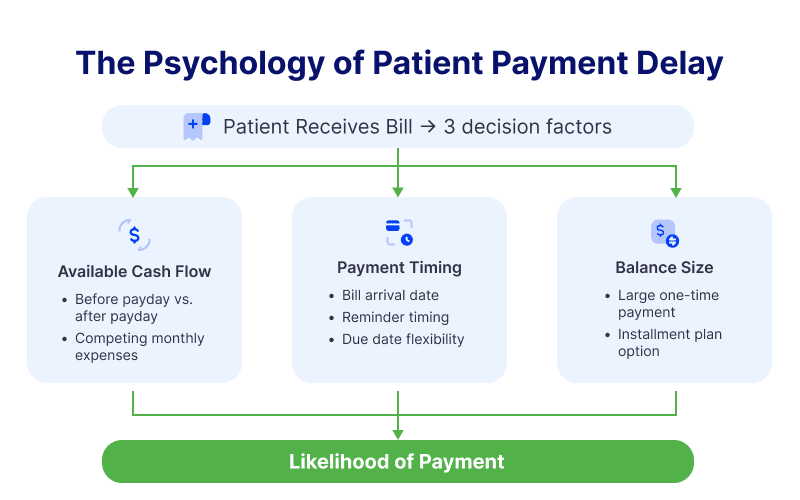
Medical expenses often compete with other household obligations and available financial resources. A 2022 KFF survey found that one in five U.S. adults has experienced problems paying medical bills and, among those, 63% used all or most of their savings to cover them. It also found that about half of adults would be unable to pay an unexpected $500 medical bill without borrowing.
These financial pressures help explain why payment behavior can vary based on balance size and affordability. A large lump-sum balance may be difficult for a patient to absorb at once, even when they intend to pay. Smaller, more manageable payments can make the financial obligation feel achievable rather than something that must be postponed.
For many consumers, financial availability fluctuates throughout the month. A medical bill that arrives three days before payday gets pushed. The same bill, arriving the day after a paycheck hits, gets paid the same day.
Patients also evaluate medical bills alongside rent, utilities, and groceries, and affordability often shapes whether a patient pays, not just when.
Aligning Patient Payment Options and Outreach With Patient Behavior
Payment plans and installment options take a scary lump sum and turn it into something a patient can actually say yes to. That alone moves a lot of stalled balances.
Similarly, timing the reminders matters. A text or email that lands right after payday will outperform the same message sent the day before rent is due.
Medical practices can strengthen these efforts by using payment analytics to identify engagement patterns, payment preferences, and response trends. Understanding when patients are most likely to pay lets practices refine outreach strategies and create a more effective patient payment experience.
By aligning payment options and communication strategies with how patients actually behave, healthcare practices reduce payment delays, not by asking more of patients but by reducing what they’re asked to do.
Reducing Patient Payment Friction to Improve Collections
Patient payment performance is increasingly shaped by the quality of the payment experience. Patients want to pay when they understand their financial responsibility, can use convenient payment methods, and receive the right prompts throughout the payment journey.
As consumer expectations continue to influence healthcare interactions, practices that reduce payment friction can strengthen both collection performance and patient satisfaction. Clear statements, flexible payment options, and proactive engagement strategies help transform patient payments from a source of administrative burden into a financial strategy.
CollaborateMD by EverHealth helps practices simplify patient payments through integrated medical billing and payment capabilities. With electronic statements, secure payment options including Apple Pay, Google Pay, ACH, online payment links, and the patient portal, CollaborateMD helps reduce friction throughout the patient payment journey while improving collections, operational efficiency, and revenue cycle performance.
Talk to an expert to learn how CollaborateMD can help your practice reduce payment friction, accelerate collections, and make patient payments a part of your overall revenue strategy.