Executive Summary
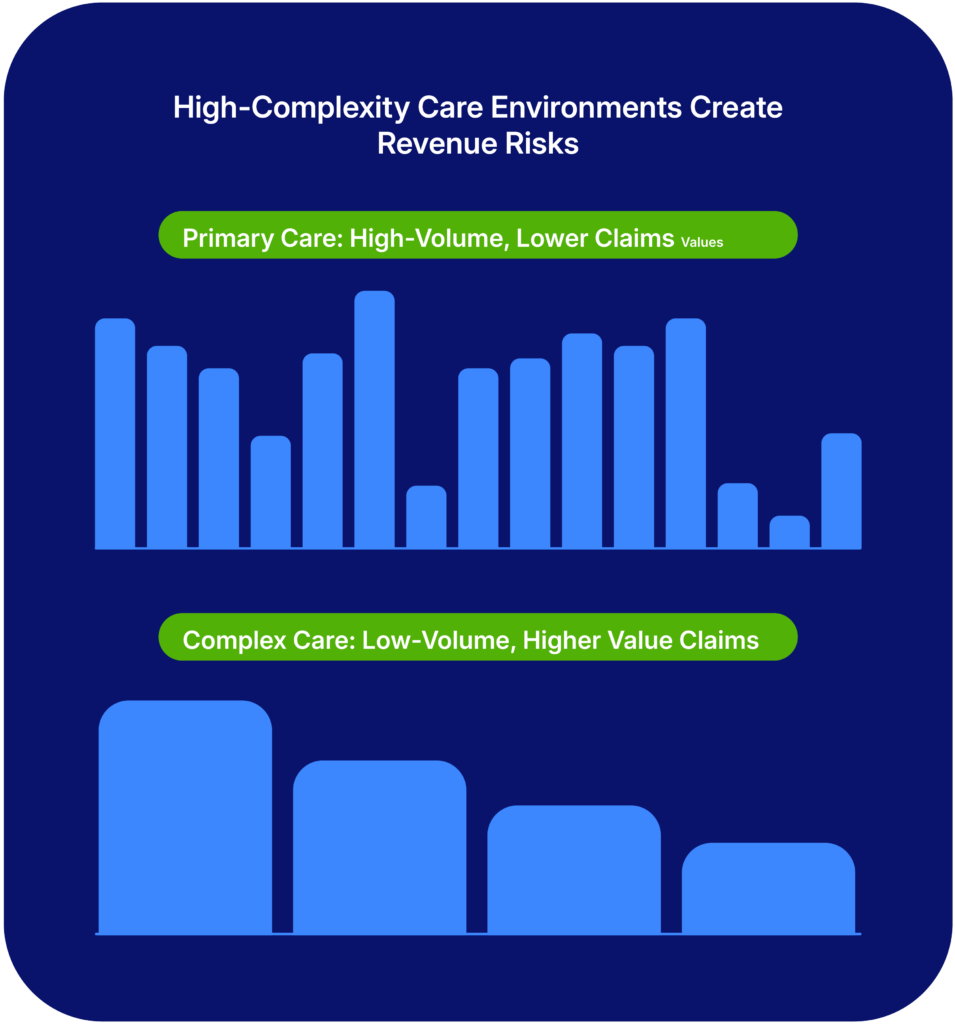
Managing revenue cycles in high-complexity care environments presents fundamentally different challenges. Processing fewer claims at higher values means every reimbursement carries significant weight on a practice’s bottom-line financial performance. A single-surgeon orthopedic practice, for example, might complete around five joint replacement procedures per month, with The Journal of Arthroplasty citing an average fee of $9,238 per procedure. This means just one procedure represents up to 20% of monthly collections. When a complex molecular diagnostic panel comprises a similar share of a laboratory’s monthly revenue, the financial exposure created by traditional, retrospective revenue cycle management (RCM) approaches becomes difficult to justify.
The pressure to protect revenue in high-complexity settings is increasing because of rising denial rates and a reduction in collections. Healthcare Finance News reported that claim denial rates in 2024 were 11.8%, representing a 15.7% increase since 2020, while collection rates dropped from 37.6% to 34.4% over the previous year. In 2025, the American Hospital Association (AHA) reported that hospitals spent $18 billion overturning claims denials and $43 billion collecting owed payments from insurers. Although these numbers relate to hospital environments, the pressure on ambulatory surgery centers (ASCs) and laboratory billing is even greater, with fewer, higher-value claims representing entire percentage points on the bottom line.
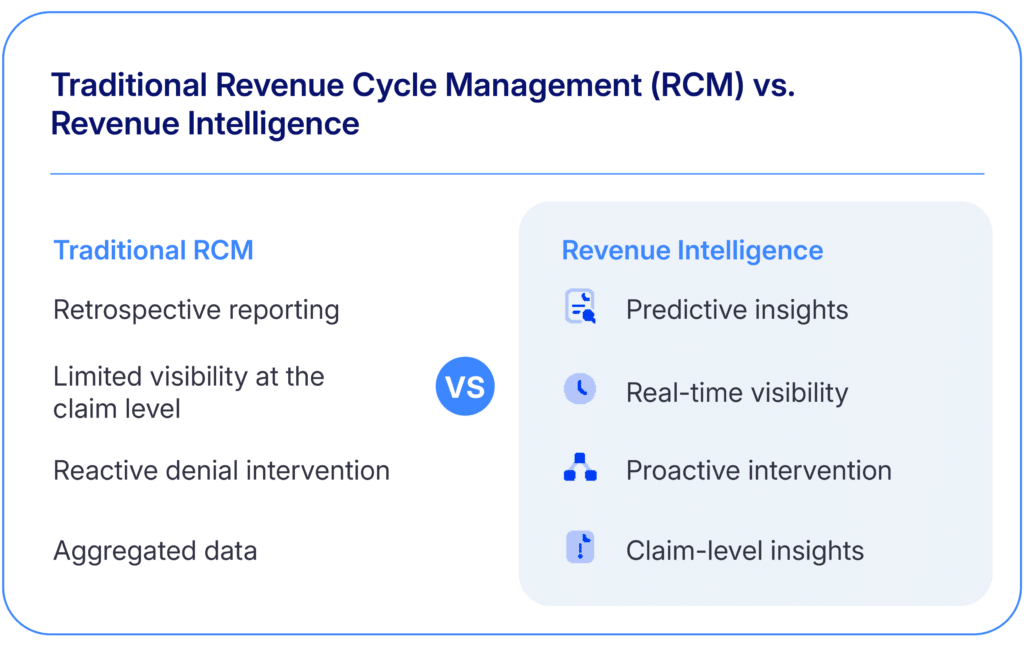
In complex care settings, even one denial has a significant impact on practice performance and materially affects monthly revenue. Traditional reporting methods, which rely on aggregated data, typically fail to give case-level visibility, which practices need to get ahead of denials. Decision-makers struggle to identify payer patterns because there are so many variations in their rules and reimbursement processes, making revenue difficult to predict.
Revenue intelligence introduces a more proactive approach to billing. With it, practices are equipped to combine real-time visibility into claims and predictive alerts to better identify risks and intervene much earlier in the claims process. Revenue intelligence reframes financial management as a predictive discipline where claim performance patterns, payer behavior analysis, and integrated forecasting transform volatility into informed strategy.
Why Revenue Behaves Differently in High-Complexity Care, and How It Impacts Financial Performance
Ambulatory surgery centers processing joint replacements, laboratories managing molecular diagnostics, and multi-specialty groups coordinating procedural revenue across orthopedics, cardiology, and gastroenterology operate in fundamentally different financial environments than primary care. For example, a family medicine clinic might absorb a denied $150 office visit with minimal disruption. But a denied spinal fusion claim destabilizes an entire month’s cash flow. Let’s explore why these environments produce such different financial dynamics.
High-Value Claims and Revenue Concentration
An ASC that performs 20 procedures per month concentrates its revenue across those 20 claims. The financial weight of each claim far exceeds what primary care practices encounter across thousands of lower-dollar patient visits.
This concentration creates exposure at every stage of the claims lifecycle. A single delayed reimbursement shifts accounts receivable by weeks, and a single denial reduces monthly collections by a significant percentage of monthly revenue. When multiple claims from the same payer stall simultaneously, the cash flow impact threatens the entire operation’s financial stability.
Aggregated reporting often obscures this reality. For example, a dashboard showing a 95% clean-claim rate still allows for individual high-dollar claims to sit unresolved without triggering attention. This happens precisely because the financial risk lives at the case level, not in portfolio-wide averages.
Case Variability and Complexity
High-complexity care also introduces variability at the individual procedure and diagnostic level. A multi-procedure surgical case involving arthroscopic repair with concurrent ligament reconstruction requires different documentation, coding, and payer requirements than a standalone procedure performed in the same facility. Likewise, complex laboratory panels that combine molecular and cytogenetic testing follow a similar pattern. Each test component may carry its own medical necessity justification and payer-specific coverage criteria.
This variability undermines the effectiveness of standardized or templated billing workflows. Each case encompasses different service combinations, modifier requirements, and clinical documentation thresholds for reimbursement. For procedural billing teams in ASCs and laboratories, where individual claims carry outsized financial weight, even small inconsistencies in documentation or coding directly suppress reimbursements.
This is a structural challenge inherent to complex care. It’s not an efficiency problem that faster processing solves.
Payer Behavior and Reimbursement Patterns
Payer behavior makes reimbursement even more unpredictable. Approval criteria, medical necessity interpretations, and reimbursement timelines vary widely from payer to payer. These variations produce worrying financial consequences. Denial rates vary significantly by payer. According to the Kaiser Family Foundation (KFF), Humana had a 5.8% denial rate in 2024 compared with UnitedHealth Group’s 12.8%.
Let’s take, for example, a laboratory that regularly runs a specific molecular diagnostic test. One payer consistently approves and reimburses the test without friction. Another requires additional clinical documentation, imposes pre-authorization delays, or denies the initial claim only to reimburse on appeal. The test, clinical indication, and documentation may be nearly identical, but the outcomes aren’t.
And for ASCs, similar dynamics play out with procedural claims. For example, a payer that reimburses a knee arthroplasty without issue may scrutinize the same procedure performed by a different provider or at a different facility.
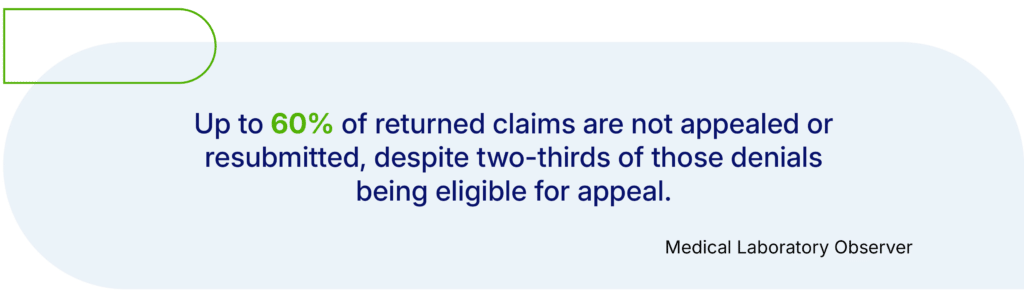
Appeals and resubmissions have become routine components of the reimbursement process in high-complexity care. According to the American Medical Association (AMA), practices complete 39 prior authorization requests per week, on average, and spend 13 hours on the process. For those already stretched thin, this represents a high administrative cost.
Payer patterns that slow down reimbursement only become clear after a denial or resubmission, meaning the impact on revenue has already occurred.
How Revenue Intelligence Capabilities Enable Proactive, Predictable Financial Management
The challenges outlined above are all made worse by limited visibility and reactive processes. Despite the availability of revenue intelligence tools, most group practices still automate less than 40% of revenue cycle management processes, according to the Medical Group Management Association (MGMA). Revenue intelligence addresses this directly by shifting the financial management model from one that responds to problems after they occur to one that identifies and manages risk before it impacts revenue.
Real-Time Visibility Over Claims
Visibility at the individual claim level is critical when, for instance, a single procedure or lab test represents a significant share of monthly revenue. Rather than relying only on aggregated, retrospective reporting, practices gain transparency into the full claim lifecycle from documentation through payer response and reimbursement.
This visibility spans clinical systems and billing platforms, creating a unified financial view that eliminates the blind spots caused by siloed data. When clinical documentation, coding, claim submission, and payer response data all feed into a single view, billing teams have the capacity to identify stalled claims, documentation gaps, and submission errors as they develop. They’re no longer discovering these errors weeks later in a monthly report.
For ASC administrators overseeing procedural revenue and laboratory directors managing complex test billing, this kind of real-time awareness changes financial management entirely.
The infrastructure supporting this visibility matters as much as the insights it produces. When clinical and financial data remain separated across disconnected systems, the risk of blind spots grows proportionally with operational complexity.
An integrated financial architecture ensures that claim performance data, payer response patterns, and documentation quality metrics converge in a single environment. This matters most for multi-site practices and billing companies managing dozens of clients. For them, this convergence is what makes case-level and portfolio-level analysis possible simultaneously.
Predictive Insights into Claim and Revenue Outcomes
Revenue intelligence platforms use historical data to identify patterns and predict reimbursement outcomes for individual claims before they’re submitted. These predictive models analyze all aspects of a case, including procedures, diagnostics, documentation completeness, and payer-specific patterns. Then, they surface risk factors that correlate with denial or underpayment.
This represents a meaningful shift from reactive to proactive risk management. Instead of discovering that a particular payer consistently denies a specific procedure combination after accumulating months of denial data, practices can flag high-risk claims at the point of submission and then preemptively strengthen their documentation.
The transition from historical reporting to predictive financial modeling also allows finance teams to present revenue projections grounded in data. In high-dollar claim environments, where the difference between a projected and actual collection rate represents tens of thousands of dollars, this precision directly supports better strategic decision-making.
Payer Pattern Recognition
Revenue intelligence models identify behavioral patterns at the individual payer level across procedures, providers, and care settings. This capability is particularly valuable in high-complexity environments.
When they surface these patterns systematically, practices proactively manage recurring denials, detect underpayment trends, and close documentation gaps before they result in lost revenue. ASC operators and laboratory directors can thus allocate administrative resources accordingly and adjust submission strategies to reduce friction.
Ongoing Revenue Monitoring and Proactive Intervention
Continuous monitoring enables early intervention because practices can track claim progression at the case level and intervene based on risk rather than waiting for a denial to appear. The result is fewer resubmissions, higher first-pass collection rates, and more stabilized cash flow.
This approach also supports more accurate forecasting. When leadership teams have visibility on which claims are progressing normally and which are stalling, they project revenue with greater confidence.
Strategic Applications of Revenue Intelligence
The value of revenue intelligence becomes clearest when applied to real-world operational challenges.
Getting Real-Time Financial Visibility in Complex Environments
Practice Care Management Group (PCMG) sought a practice management system with “super-client” functionality—in other words, the ability to share certain lists, tables, and reports across all databases. This capability allows them to analyze their business from both the individual client-level and holistically.
Supporting 300 healthcare providers across 100 different practices, PCMG needed to be able to track both individual cases and broader financial trends without toggling between disconnected systems. After implementing CollaborateMD by EverHealth, a cloud-based medical billing and patient management system, they reduced processing time by 48% and enabled their clients to automate claims and payment cycle tasks.
Managing Operational Complexity in Multi-Provider or Multi-Site Settings
BlueSky Health, a multi-provider practice, faced many challenges due to rapid growth, including inefficient billing workflows, slow reimbursements, and outdated systems. After switching to CollaborateMD, it saw dramatic improvements in claims processing time and staff satisfaction.
As their office manager puts it, “Not only does CollaborateMD help streamline our billing process, but, with the way it is integrated with our EHR, it saves so much time. Getting paid faster is essential to running a business. We aren’t waiting on payments or wasting time researching unpaid claims.”
Optimizing Revenue Management to Improve Financial Performance
For Suffern Podiatry, the challenge was the time spent on claim management and the revenue risks that billing problems create for smaller practices. As Dr. Howard Friedman noted, a billing problem “could be devastating and take months to undo.”
CollaborateMD’s dashboards and smart alerts enabled the practice to get ahead of rejections and errors. This helped them protect cash flow and reduce the operational anxiety that comes with managing revenue reactively.
Turning Complex Care Revenue Operations into Predictable Financial Performance
For ASC operators managing procedural revenue, laboratory directors overseeing billing environments, and multi-specialty group leaders coordinating diverse revenue streams, the path to stability, not volatility, runs through intelligence. Revenue intelligence transforms procedural revenue volatility into strategic predictability. By integrating transparency, predictive modeling, and payer pattern recognition, organizations stop simply reacting to their reimbursement challenges and start preventing them instead.
High-complexity care will always involve payer scrutiny, documentation demands, and procedural variability. The question is whether leadership teams have the infrastructure to predict and manage those challenges or whether they discover them only after revenue has already been lost. Revenue intelligence provides that infrastructure.
Contact us to learn how CollaborateMD can help your practice move from reactive revenue management to predictive financial performance.