Executive Summary
Medical billing teams are under pressure to manage more claims, more payer requirements, and more follow-up work without adding unnecessary administrative burden.
Many practices already use automation software to speed up parts of the revenue cycle, but the operation is still built around volume-based manual work: staff still review routine claims, find medical billing issues only after denial, and require more headcount as claim volume grows.
The Council for Affordable Quality Healthcare’s 2025 Index found a $21 billion savings opportunity through full automation of manual and partially manual transactions. AI medical billing helps teams move toward an exception-based workflow, where routine claims move forward with less manual review, higher-risk claims are flagged earlier, and complex issues are routed to experienced billers.
In this model, practices have a more scalable and operationally mature way to manage revenue cycle management (RCM). Let’s look at how smart RCM operations can transform medical billing and help your practice unlock more predictable revenue cycle performance and preserve margins.
Staff Review Every Claim, Even When They Don’t Need To
In most medical billing operations, every claim gets reviewed before submission, regardless of how simple or complex it is. According to the Medical Group Management Association (MGMA), only 40% of claims are zero-touch. That means a large share of claims still requires human intervention before payment.
Many routine claims don’t require human judgment because they follow predictable patterns. Claims with complete patient details, active eligibility, expected coding, and no obvious payer-specific issues often enter the same work queue as complex claims and compete for the same staff attention.
In volume-based workflows, staff waste time reviewing routine claims because they’re in the queue. It becomes harder to prioritize claims with missing information, unusual code combinations, payer-specific requirements, or higher denial risk.
AI Moves Routine Claims Forward Without Manual Review
In a more mature medical billing workflow, the goal isn’t simply to process more claims faster—it’s to reduce the number of claims that require human touch in the first place. Instead of treating every claim as if it needs the same level of review, AI claim review optimization identifies routine claims that meet expected criteria and moves them forward without manual review.
Routine claims can be submitted faster, and staff time is focused on the claims that actually need attention. Billing teams can increase throughput without adding headcount.
Medical Billing Problems Are Found After Submission
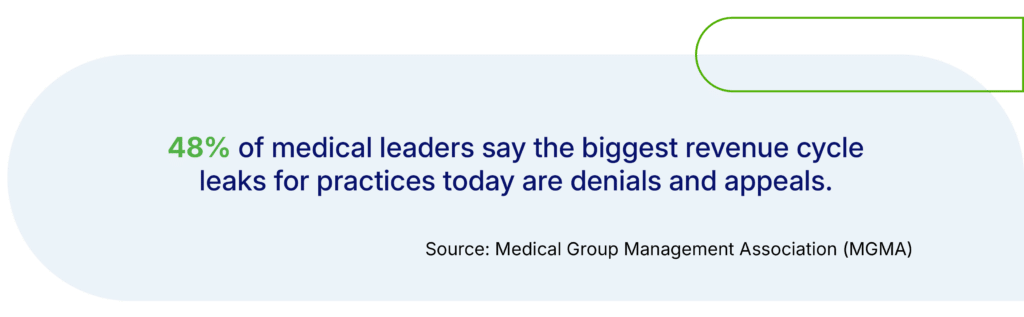
Many billing problems aren’t found until after a claim has already been submitted. Coding errors, missing documentation, eligibility issues, and authorization gaps may only be visible when the payer delays, rejects, or denies the claim. MGMA found that the biggest revenue cycle leaks for practices today are denials and appeals.
But many errors, like missing documents or eligibility issues, can be addressed earlier. The Healthcare Financial Management Association (HFMA) notes that 90% of denials are preventable.
The problem is timing. When preventable issues are found after submission, the medical billing team has to spend more time investigating what went wrong, correcting the issue, and resubmitting the claim or filing an appeal. This reactive approach increases denials, slows cash flow, and adds unnecessary workload.
AI Flags High-Risk Claims Before They Become Denials
Intelligent RCM workflows shift denial management earlier in the process. Before claims are submitted, billing anomaly detection can check for warning signs, such as missing documentation, eligibility problems, authorization gaps, unusual code combinations, or prior denial trends.
MGMA found that prior authorization issues (42%), demographic problems (29%), coding errors (23%), payer requirement inconsistencies (14%), and missing documentation (11%) are among the most common denial sources reported by healthcare leaders—most of which are detectable before submission.
In exception-based billing, those warning signs can trigger staff review before the claim reaches the payer. Teams get the chance to address risks earlier, which reduces rework, improves first-pass accuracy, and makes revenue cycle performance more predictable.
Medical Billing Can’t Scale Without Adding People
As claim volume grows, traditional medical billing workflows require more human involvement: more claims to review, more denials to work, more payer follow-up, and more billing questions to manage.
If every increase in claim volume creates a proportional increase in manual work, billing becomes harder to scale without adding staff. This is a real constraint for growing practices. A 2024 MGMA survey found that unfilled positions, including revenue cycle staff and coders, directly affect practice scalability.
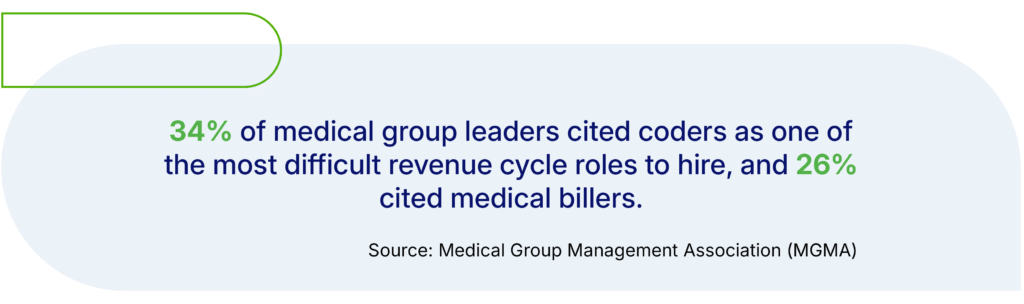
But those roles are hard to fill. Another MGMA Stat poll found that 34% of medical group leaders cited coders as one of the most difficult revenue cycle roles to hire, while 26% cited medical billers. Even when practices do fill open roles, new staff bring hiring delays, training needs, and management overhead.
At that point, billing becomes a limitation, not a scalable function.
AI Helps Reduce Manual Work as Medical Claim Volume Grows
Smart RCM operations help medical billing teams scale by shifting routine work into exception-based workflows. Routine claims move forward automatically, while only complex or risky claims are routed to staff for review.
By reducing the amount of work that needs direct staff involvement, practices can support higher volumes with existing teams. Growth becomes less dependent on headcount, which helps preserve margins as the practice scales.
Experienced Staff Spend Time on Low-Value Work
Experienced billers bring the most value when they’re working on claims that need interpretation, payer knowledge, or human judgment, such as complex denials, authorization requirements, and edge cases. But in many medical billing workflows, they’re stuck doing low-value work.
It’s inefficient and can also create frustration and disengagement among staff when their expertise is not applied where it matters most. The American Academy of Professional Coders (AAPC) found that excessive workloads, burnout, and feeling underappreciated are the top reasons cited for poor staff retention rates in billing.
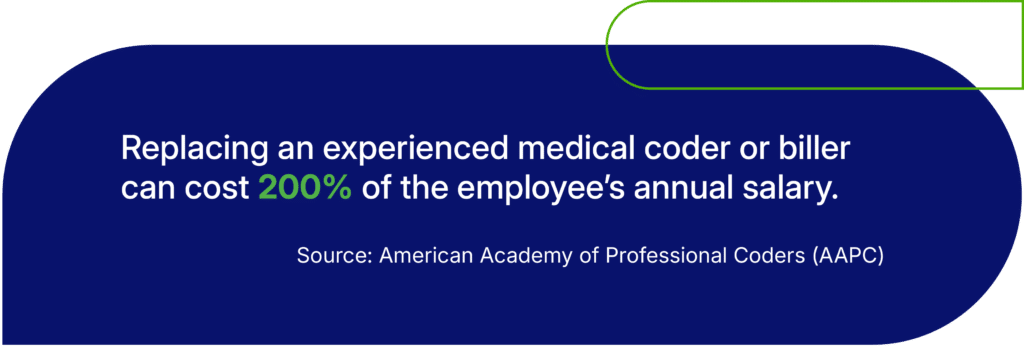
Practices lose valuable payer knowledge, internal workflow knowledge, and practical experience that takes time to rebuild when experienced billers leave. That loss also comes at a cost. According to AAPC, the cost to replace an experienced medical coder or biller is 200% of the employee’s annual salary, on average.
AI Routes Complex Claims to the Right Staff
AI triages claims during the intake process, so routine claims move forward, and complex claims are routed to the right staff. Humans stay in control of the work that needs oversight, while the system reduces unnecessary manual work.
With less time spent on routine processing, complex billing issues can be handled more carefully, experienced billers can focus on meaningful work, and operations become more efficient.
AI’s Value Is Workflow Transformation, Not Just Task Automation
The real value of medical billing automation is not doing the same tasks faster. It’s helping practices build a more mature operating model where routine work doesn’t compete with the work that requires human judgment.
A more mature billing workflow also needs the right operational foundation. In an exception-based workflow, teams need visibility into claims, payments, follow-up, and performance so staff can focus on the right work.
CollaborateMD by EverHealth supports that operational foundation by helping practices manage claims, payments, follow-up, and performance in one connected workflow. With clearer visibility and less friction, medical billing teams can focus their time more effectively.
Talk with an expert and discover how CollaborateMD can help your practice build a more efficient revenue cycle workflow.