
As commercial payer variability, Medicaid policy shifts, and growing patient responsibility continue to reshape revenue assumptions, finance leaders need stronger financial modeling and earlier visibility into change. In today’s volatile environment, predictive revenue cycle management becomes a strategic capability that helps practices adapt faster.
The goal is not to avoid volatility, but to understand it earlier, model its financial impact more clearly, and respond before it turns into a larger problem. A predictive approach to revenue gives leadership a more practical way to test assumptions, quantify exposure, and plan with greater confidence.
This article looks at four areas where revenue instability shows up most clearly—long-term strategic planning, patient payment behavior, Medicaid-driven payer mix changes, and contract negotiations without a clear performance baseline. We also offer strategic solutions for addressing these areas of instability and improving revenue cycle management.
Unpredictable Payer Changes Undermine Long-Term Planning
Payer volatility is a structural financial planning issue for practices. Commercial contract changes, policy-driven shifts in coverage, patient-responsibility uncertainty, and administrative friction can all change revenue assumptions faster than leadership teams can update a fixed plan.
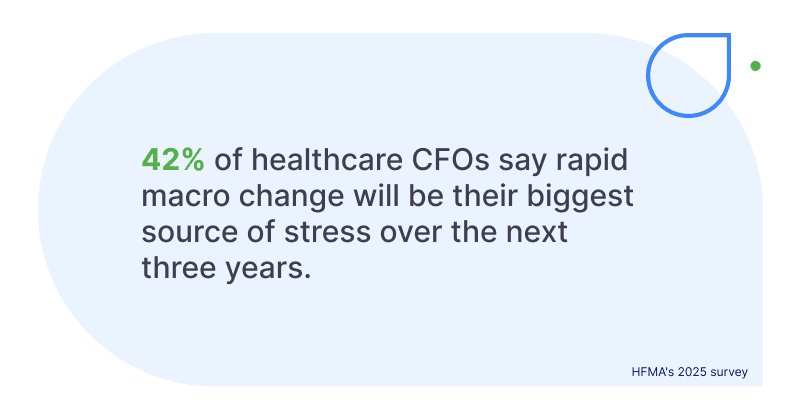
In a 2025 survey conducted by the Healthcare Financial Management Association (HFMA), 42% of healthcare CFOs said their greatest source of stress over the next three years will be positioning their organization for success through a period of rapid macro change.
Practice leaders often build multi-year strategic plans based on current payer mix, reimbursement rates, and collection patterns, but these assumptions can change before the plan has time to play out. If reimbursement conditions shift mid-cycle, decisions around staffing, expansion, capital allocation, and provider compensation become less reliable.
Even when changes are expected, they can still undermine the reliability of long-term planning. The Centers for Medicare and Medicaid Services (CMS) said average payment rates under the Medicare Physician Fee Schedule were reduced by 2.93% in calendar year 2025 compared with most of calendar year 2024. For practices already managing tight margins, a change like that can affect budgets, provider compensation plans, service-line investment, and financial targets.
Medicare can also change the payment formula behind specific services, which can affect how financially viable those services are for a practice. The American Medical Association’s (AMA) 2026 Medicare physician fee schedule noted a reduction in practice expense relative value units (RVUs) for physician services provided in medical facilities, including ambulatory surgical centers and hospitals. As a result, many clinicians face cuts, including 81% of infectious disease physicians and 54% of ophthalmologists.
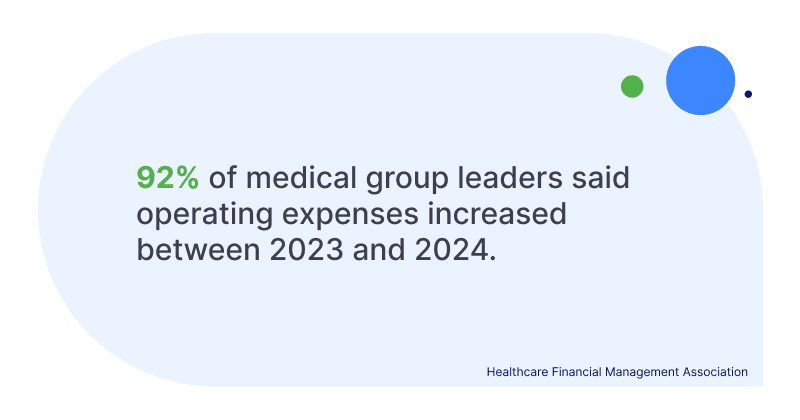
The pressure is harder to absorb when costs are already rising. In a June 2024 Medical Group Management Association (MGMA) Stat poll, over 90% of medical group leaders said operating expenses had increased compared with 2023.
That leaves practices with less room to absorb payer-driven changes without making cuts elsewhere. Even relatively modest reimbursement changes can force leadership to revisit assumptions that were meant to support longer-term decisions.
Strategic Solution: Use Scenario-Based Planning to Adapt Confidently to Payer Change
Medical practices need a clearer way to test assumptions, compare downside risk, and adjust strategy earlier. That starts with replacing fixed long-term planning assumptions with scenario-based planning.
Instead of building forecasts around one expected outcome, leadership can model multiple payer scenarios and estimate how each one could affect revenue, margins, and cash flow. For example, a practice might model what happens if a major payer reduces reimbursement, if denial rates rise, or if a larger share of revenue shifts to slower patient collections.
The goal isn’t to predict exactly what will happen, but rather to understand which assumptions create the most financial exposure. Practices can then define decision triggers in advance to know when changing payer conditions should prompt action, whether that means revisiting hiring plans, pausing expansion, or adjusting service-line investment, and use reporting to track which scenario is beginning to materialize.
By building uncertainty into the planning process, leadership can adapt strategy as conditions change more confidently. They also gain a clearer framework for explaining risk, evaluating tradeoffs, and aligning next steps across the organization.
Growing Patient Responsibility Weakens Cash Flow Predictability
As insurance design shifts more costs to patients through deductibles, coinsurance, and copays, a larger share of practice revenue becomes challenging to predict. While the third-party payer portion is relatively predictable and stable, patient responsibility isn’t.
Some patients pay at the time of service, some pay partially over time, some delay payment, and some never fully pay. Even when a balance appears in accounts receivable, the timing and likelihood of collection can vary. That makes cash flow harder to forecast because practices struggle to estimate how much unpaid revenue will actually convert into cash and when it will arrive.
The American Hospital Association (AHA) also warns that higher out-of-pocket maximums translate into more bad debt and uncompensated care when patients cannot pay their share of costs. For practices, this means patient balances are no longer a dependable stand-in for expected cash flow.
Strategic Solution: Use Patient Revenue Predictability Modeling to Improve Cash Flow Planning
Practices need to stop treating billed patient balances as if they’ll all be collected in full. A more strategic approach is to model patient-responsibility exposure more realistically by looking at how different balances, payment patterns, and patient segments behave over time.
A medical practice can analyze its own collection data and historical payment behavior. It may, for example, find that smaller balances paid through established payment plans are collected more reliably than larger balances billed after the visit, or that certain patient groups tend to pay more slowly than others.
That visibility helps leadership estimate which portions are more likely to convert into cash, which are more likely to be delayed, and where collection risk is most concentrated. Practices can treat growing patient responsibility as a manageable planning variable rather than a recurring surprise and plan ahead accordingly.
Medicaid Policy Shifts Create Revenue Mix Volatility
Practices in states with unstable Medicaid policy environments face a different kind of planning challenge than routine reimbursement updates. Policy shifts can affect who’s covered, what payer mix looks like, and how much revenue is realistically collectible.
Medicaid expansion and contraction both change revenue economics. Expansion can bring in more covered patients, but often at lower reimbursement rates than commercial insurance. Contraction can reduce covered volume and leave more patients uninsured or moving in and out of coverage, which makes collection less predictable.
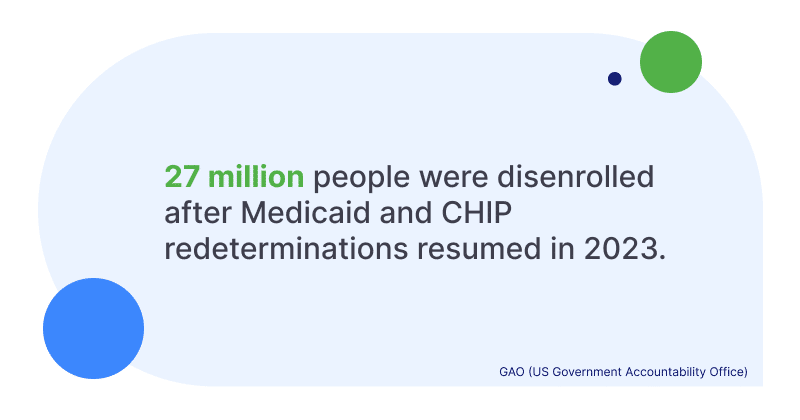
Recent research from the US Government Accountability Office (GAO) found that 27 million people, roughly one-third of enrollees, were disenrolled after Medicaid and CHIP redeterminations resumed. The GAO also found that in six states, fewer than 20% of people were disenrolled, while in 12 states, more than 40% were disenrolled. Variation across states makes the financial impact harder to plan for, especially for organizations operating across different markets.
Losing Medicaid does not always automatically mean a patient moves directly to another insurance plan. In KFF’s Survey of Medicaid Unwinding, 70% of adults who were disenrolled said they became uninsured when they lost Medicaid, even if some later obtained other coverage.
Medical practices may see revenue shift in two ways at once: fewer visits tied to Medicaid reimbursement, and more patients without stable coverage raising collection risk. For leadership, the challenge is managing the risk that a policy change could quickly reshape the practice’s revenue base.
Strategic Solution: Use Payer Mix Scenario Modeling to Prepare for Medicaid Policy Change
Payer mix scenario modeling helps practices better manage Medicaid volatility by estimating the financial impact of policy changes before they happen.
The first step is getting a clear view of the current payer mix economics, including how much revenue comes from Medicaid, how Medicaid reimbursement compares with other payer types, and how coverage changes affect both volume and collections.
With that baseline in place, leadership can then model different policy scenarios and how each one could affect revenue, margins, and cash flow. Scenario planning can test questions like, “What happens if Medicaid enrollment increases,” “What happens if disenrollment reduces covered volume,” or “What happens if payer mix changes faster in one market than another?”
Scenario modeling also helps separate temporary disruption from structural payer mix change, which is critical when decisions about staffing, growth, or reserves need to be made before the full financial impact appears in monthly results.
Practices can use that insight when explaining risk or advocating for their needs.Contingency plans can be activated faster when policy changes take effect, and financial reserves and borrowing plans can be sized more realistically for Medicaid-related risk.
Contract Negotiations Are Harder Without a Performance Baseline
When commercial payer contracts come up for renewal, many practices are negotiating blind. Because they don’t have a clear picture of what the current contract is actually delivering, they often end up focusing solely on the proposed rate.
But a contract’s financial value depends on more than just the rate. It also depends on the complete revenue equation, including reimbursement by service type, denial patterns, authorization requirements, payment timing, and administrative effort required to get paid.
Without that full view, leadership can’t answer the important questions.
- Which payer is actually performing well?
- Which payer looks acceptable on paper but creates more revenue friction in practice?
- How would a proposed rate change affect net revenue once operational costs are factored in?
Payers may propose new rates and terms, but practices are not always in a strong position to model the financial impact of those changes. Too often, the negotiation becomes an accept-or-reject decision rather than a strategic discussion informed by data.
Two contracts with similar fee schedules may still not produce the same financial outcome once payment delays, rework, and collection friction are taken into account.
In the AMA’s 2024 prior authorization physician survey, 75% of physicians said prior authorization denials had increased somewhat or significantly over the last five years. A payer may offer acceptable reimbursement, but still create enough friction through prior authorization and administrative burden to make revenue less predictable and more costly to realize.
If a practice cannot quantify what the current arrangement is really delivering, it’s much harder to model proposed changes, identify walk-away points, and push back with evidence.
Strategic Solution: Model the True Economic Value of Payer Relationships Before Renewing Contracts
Before renewal, practices need a more structured way to evaluate what each payer relationship is actually worth. A stronger approach is to model contract value through the full revenue equation. That means tracking reimbursement by service type, denial rates, payment timing, and administrative burden per payer—not just the headline rate—and using that performance history as a baseline going into renewal discussions.
This helps leadership distinguish between contracts that support revenue predictability and contracts that create revenue friction. Instead of judging a payer relationship by rate alone, practices can see whether revenue is realized in a way that supports more stable planning and more sustainable financial performance.
Practices don’t need to react passively to a payer’s rate proposal any longer because they have the context to compare new terms against the current economic value of the relationship and determine whether those terms improve long-term revenue predictability.
Predictive Revenue Cycle Management Helps Practices Plan With Greater Confidence
It’s difficult to plan with confidence when revenue assumptions shift mid-cycle. Predictive revenue cycle management doesn’t eliminate uncertainty; it makes revenue performance easier to model, monitor, and respond to as payer conditions change.
Revenue intelligence has become an essential infrastructure for planning through uncertainty. Practices that build predictive revenue infrastructure can model ‘what-if’ scenarios, quantify exposure, and trigger adaptive strategies. This transforms volatility into a manageable planning variable.
This is where practice management and billing infrastructure become more strategic. In a volatile reimbursement environment, day-to-day revenue activity needs to do more than support operations. It also needs to support planning. When claims, payments, balances, and reimbursement trends are easier to follow over time, leadership is in a better position to improve forecast accuracy, test scenarios, and respond faster as conditions change.
CollaborateMD by EverHealth provides the infrastructure that supports scenario modeling and predictive oversight. The platform supports core revenue-cycle workflows, including real-time claim submission, eligibility verification, scheduling and task management, patient billing and payments, and claims management—all in one connected system.
Practices also gain access to more than 125 standard reports plus analytics dashboards that track financial performance and key metrics across payers, service lines, and patient payment activity over time. That visibility gives leadership the infrastructure to move from tracking what happened to anticipating what’s likely to happen next. Combining medical billing and practice management workflows in one system, CollaborateMD gives practices a clearer view of how revenue is moving across eligibility, claims, payments, and collections over time.
That shortens the gap between revenue change and leadership response, strengthens scenario planning, and supports more resilient planning under uncertainty. Planning can become less reactive and more deliberate. See how CollaborateMD helps you plan with greater confidence—talk with an expert today.