
Primary care practices operate in one of healthcare’s most operationally demanding billing environments. Unlike procedure-based specialties with narrower workflows, primary care practices manage high patient volumes, multi-condition encounters, preventive services, chronic disease management, and fragmented payer requirements simultaneously.
As reimbursement rules continue evolving, even small workflow inefficiencies can accumulate quickly across thousands of monthly claims, creating growing administrative strain and revenue instability. That pressure is intensifying. Denial rates are climbing as payers increasingly rely on algorithm-based claim reviews. According to the Healthcare Financial Management Association (HFMA), payers have been using AI-powered audits to generate faster and more frequent denials for several years now. Krysten Blanchette, vice president of revenue cycle, Care New England, Providence, RI, says denials are becoming more difficult because “more claims are being denied and payers are taking longer to respond.”
For many practices, medical billing teams are still expected to manually navigate payer-specific rules, coding variations, documentation requirements, and denial management processes while maintaining productivity in high-volume environments. This guide explores the operational realities driving primary care billing complexity and outlines how workflow standardization, payer-aware automation, and scalable billing infrastructure can simplify revenue cycle management.
The Operational Realities Driving Primary Care Billing Complexity
Medical billing will never be simple. That’s because the billing challenges aren’t caused by isolated mistakes or inefficient staff. They stem from the structure of primary care itself, where providers are expected to manage diverse patient needs, evolving payer requirements, and large claim volumes simultaneously.
Some of the biggest operational challenges begin at the encounter level itself.
Primary Care Visits Rarely Fit Into Simple Medical Billing Categories
Unlike procedural specialties with narrower, more predictable visit structures, primary care centers on whole-person, longitudinal care. Physicians routinely address multiple overlapping conditions and care objectives within the same encounter, creating coding complexity that practices can’t easily standardize through simplistic workflows.
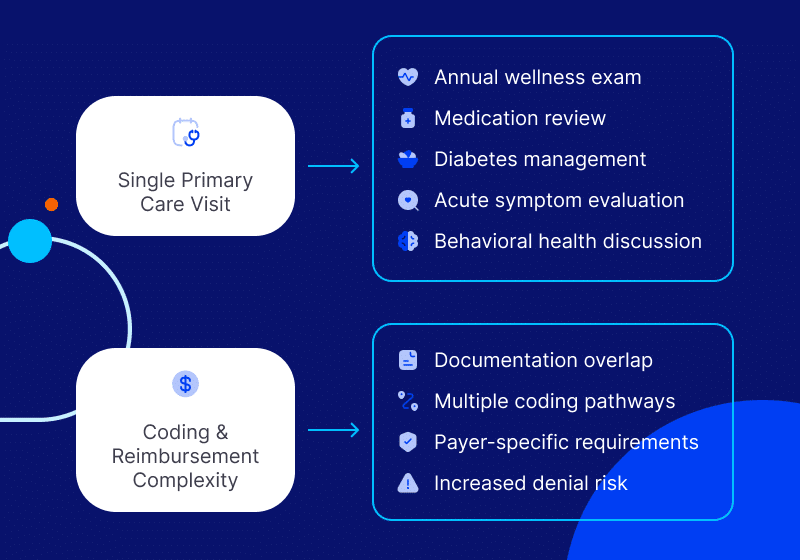
The challenge isn’t simply documentation accuracy. It’s operational variability.
- A preventive visit may evolve into chronic disease management.
- A medication review may uncover an acute issue requiring additional evaluation.
- Different payers may apply entirely different reimbursement standards to the same encounter structure.
As clinical comprehensiveness increases, coding overlap becomes more difficult to navigate consistently.
For high-volume primary care practices, even small coding inconsistencies can create significant financial and administrative strain over time. Minor documentation gaps, when repeated across thousands of encounters, often lead to delayed reimbursements, heavier administrative workloads, and ongoing operational inefficiencies.
Primary care coding isn’t inherently flawed. Most medical billing workflows weren’t designed around the visit variability that defines primary care delivery.
To solve this issue, practices can standardize workflow designed around primary care encounter patterns, such as:
- Claim and task management workflows
- Digital intake forms
- Automated eligibility verification
Primary care practices also need payer-aware medical billing workflows and coding support tools that can better handle preventive care documentation, chronic care management, and multi-condition encounters without creating additional administrative burden.
When workflows align with the realities of primary care delivery, practices can reduce coding inconsistencies, improve clean claim performance, and achieve more predictable reimbursement outcomes—without significantly increasing administrative burden.
Payer Variation Creates Constant Administrative Friction
Primary care practices manage one of the broadest payer mixes in healthcare. Medicare, Medicaid, employer-sponsored insurance plans, commercial payers, managed care organizations, and exchange-based coverage programs frequently coexist within the same patient population.
Each payer brings its own reimbursement logic with varying:
- Documentation thresholds
- Modifier requirements
- Authorization rules
- Filing timelines
- Coverage policies
Administrative teams need to navigate these variations while maintaining operational consistency across high claim volumes. This creates structural administrative fragmentation. For example, in many practices, medical billing workflows still rely heavily on institutional knowledge and manual oversight. Staff members need to remember payer-specific rules, identify exceptions, track policy changes, and correct denials after claims are rejected.
Prior authorization requirements illustrate how operationally disruptive payer fragmentation has become. According to the American Medical Association’s 2024 prior authorization physician survey, 93% of physicians report care delays tied to prior authorization requirements, while 29% say prior authorization has contributed to serious adverse events.
For high-volume primary care practices already operating on constrained margins, these inefficiencies create serious financial strain. Practices relying primarily on manual workflows will face growing difficulty maintaining both reimbursement stability and administrative scale.
To simplify medical billing for primary care, practices need to reduce the amount of payer variation staff must manage manually. Embedding payer-specific logic directly into billing workflows can help automate documentation checks. Admin staff can apply coding requirements more consistently and identify issues before claims are submitted.
As a result, practices will be able to reduce administrative burden, improve claim consistency across different payer types, and create more stable reimbursement workflows without placing additional strain on staff.
High-Volume Medical Billing Magnifies Small Inefficiencies
Primary care runs on a high-volume, low-margin model. Here, financial stability depends heavily on maintaining efficient operations across thousands of patient encounters. That means small inefficiencies don’t stay small.
A redundant eligibility check, a minor documentation gap, or a slow denial correction process may seem manageable in isolation. Repeated across thousands of monthly encounters, these inefficiencies accumulate into significant administrative overhead and reimbursement instability.
- Manual claim review becomes harder to sustain.
- Repetitive data entry consumes staff capacity.
- Denial workflows create bottlenecks that pull resources away from higher-value work.
Administrative teams end up spending hours fixing preventable claim issues instead of focusing on higher-impact work. Over time, the operational drag starts affecting staffing, morale, and reimbursement speed.
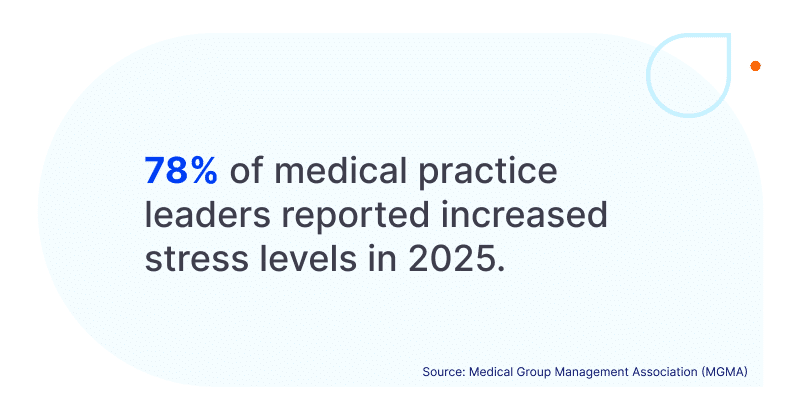
Scalability becomes a core revenue cycle challenge. Practices can’t continuously increase administrative headcount at the same pace as patient growth without creating additional financial strain. According to the Medical Group Management Association (MGMA), 78% of medical practice leaders reported increased stress levels in 2025 as operational and staffing pressures continued rising.
Medical practices can solve this problem by automating routine administrative tasks wherever possible so staff can focus more attention on exceptions, denial resolution, and revenue-impacting issues. Tools like real-time electronic claim submission, automated denial follow-up workflows, and integrated clearinghouse functionality can help reduce repetitive manual work while improving medical billing consistency.
This creates a more scalable medical billing operation, reduces administrative strain on staff, and supports more stable financial performance without requiring proportional staffing growth.
Simplification Requires Operational Infrastructure, Not Tactical Fixes
Primary care revenue cycle complexity stems from the operational realities that define primary care itself: high patient volume, multi-condition encounters, preventive and chronic care management requirements, and fragmented payer rules. Because these challenges are structural, simplification needs more than isolated process improvements or short-term administrative fixes.
Many practices still manage medical billing complexity reactively through manual oversight, staff workarounds, and small workflow adjustments. While those efforts may reduce friction temporarily, they rarely create the consistency needed to maintain stable reimbursement at scale.
Sustainable simplification starts with building infrastructure around how primary care actually operates. That means creating standardized systems capable of supporting coding consistency across variable encounters, managing payer complexity more systematically, improving visibility into revenue cycle performance, and reducing reliance on repetitive manual intervention.
Instead of relying on staff to constantly correct operational gaps, practices need workflows that build consistency directly into medical billing operations. Payer-aware workflows, integrated claim management, automated eligibility verification, denial monitoring, and real-time reporting tools work best when they function together as part of a connected operational system.
The goal isn’t to eliminate complexity from primary care medical billing. Rather, it’s to build operational models capable of managing that complexity more predictably and efficiently without continuously increasing administrative burden. When medical billing infrastructure reflects the realities of primary care operations, practices can improve reimbursement consistency, reduce administrative burden, support scalable growth, and build a more stable financial foundation over time.
Simplifying Medical Billing Complexity Creates Revenue Stability
Primary care billing complexity isn’t going away. High patient volumes, multi-condition encounters, payer fragmentation, and evolving reimbursement requirements are built into how primary care operates. The practices that find financial stability will be the ones that build systems capable of handling complexity consistently, at scale, without burning out their staff or leaving revenue on the table.
That means more than tweaking billing workflows. It means infrastructure that standardizes processes, adapts to payer variation, supports accurate coding across complex encounters, and reliably captures preventive care revenue that’s already being earned.
When practices build operations around how primary care actually works, the downstream effects are real: less administrative strain, fewer denials, more predictable revenue, and a team that spends less time firefighting.
CollaborateMD by EverHealth helps primary care organizations do exactly that with medical billing software built specifically for the demands of modern primary care.
From managing payer variation and improving reimbursement consistency across complex encounters to centralizing real-time operational insights and reducing manual re-entry errors, CollaborateMD helps reduce administrative strain while supporting more stable financial performance.
Talk to an expert to learn how we can help you simplify medical billing workflows, improve revenue cycle efficiency, and build a more scalable primary care billing operation.