
Most growing healthcare organizations end up managing multiple electronic health records (EHRs), whether they planned to or not. As organizations expand across locations, acquire new practices, and adopt specialized systems, they inherit increasingly fragmented technology environments. Before long, the revenue cycle starts feeling the strain.
EHR transitions disrupt workflows, reduce productivity, and create financial instability. Fragmented systems lead to inconsistent billing, manual workarounds, and limited visibility. Vendor lock-in restricts flexibility, making it difficult to change systems without risk. Technology incompatibility increases acquisition complexity and limits growth opportunities. Financial reporting becomes harder to align across locations. For medical billing companies managing revenue operations across multiple client practices, these pressures multiply. Every new client running a different EHR introduces new file formats, new data structures, and new operational overhead—before a single claim is ever processed.
At first glance, this looks like an interoperability issue. But these challenges are infrastructure limitations. The real issue is that infrastructure has to be flexible enough to handle change without throwing revenue operations into chaos every time a system shifts. Claims portability allows organizations to maintain performance regardless of system complexity. It ensures continuity, consistency, and control across changing environments. Universal Import creates a standardized operational layer that ingests and aligns data from different EHRs and operational systems.
This enables:
- Stable revenue operations during system changes
- Unified financial visibility across multi-EHR environments
- Freedom to change vendors without disruption
- Faster, lower-risk acquisition integration
The result is a shift from fragmented, reactive operations to controlled, scalable performance. Organizations that adopt flexible data infrastructure gain a competitive advantage through greater resilience, adaptability, and growth potential.
Revenue operations need to stay stable even while the systems around them keep changing. This guide looks at the revenue challenges created by multi-EHR environments and what healthcare organizations can do to build flexibility into their infrastructure.
The Reality of Multi-EHR Environments Is Creating Hidden Revenue Risk
Most growing healthcare organizations don’t operate inside one clean, unified technology environment for very long. New locations bring different systems. Acquisitions inherit existing workflows. Specialty groups often use platforms designed around their own clinical needs.
Eventually, all those disconnected systems start causing problems outside IT.
Revenue Disruption During EHR Transitions
EHR transitions rarely happen quietly in the background. Billing teams have to adapt to new workflows, reporting structures change, and productivity usually drops while staff learn new systems. Researchers at the University of California describe “a sharp dive in productivity because new technology shocks the existing work systems” when looking at the impact of implementation.
Multi-Location Growth Creates Fragmented Billing Operations
The more locations, specialty services, and acquired groups an organization adds, the harder it becomes to maintain a consistent financial view across the business.
On paper, the systems connect. In practice, teams still end up jumping between platforms trying to figure out which numbers are right. A 2024 study of 2,088 physicians found that only 8% said it was very easy to use information from different EHR systems.
So people start patching the gaps themselves. Teams reconcile data manually, maintain temporary reporting workarounds, and build disconnected processes just to keep workflows moving.
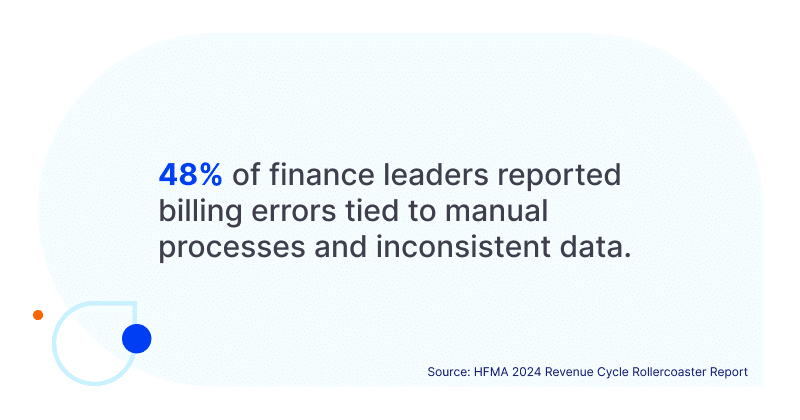
That friction quickly spreads beyond IT and operations. Research published in the Journal of Medical Internet Research found that fragmented records and delayed communication negatively affect care quality, productivity, and cost savings. HFMA’s 2024 Revenue Cycle Rollercoaster report also found that 48% of finance leaders reported billing errors tied to manual processes and inconsistent data. Outcome: More systems don’t create scale; they create complexity, inconsistency, and errors.
Growth is supposed to create efficiency. Instead, teams end up spending more time managing the systems themselves.
Medical Billing Companies Carry this Complexity on Behalf of Every Client
For medical billing companies, multi-EHR complexity isn’t an internal problem. It’s the job.
Managing revenue operations across a book of clients means managing as many data environments as there are clients. Each practice runs its own EHR. Each EHR produces its own file formats, exports data differently, and structures clinical and billing fields in its own way. When a medical billing company onboards a new client, the technical work of getting that client’s data into a usable format often begins before any actual billing work can start.
That onboarding lift is significant. Teams spend time manually mapping fields, converting file formats, reconciling identifiers across systems, and rebuilding processes that don’t transfer cleanly from one client environment to the next. None of that work generates revenue.
When a client switches EHRs, the problem restarts. New export formats, changed field structures, and updated workflows mean the billing company has to re-engineer its data intake process for that client from scratch. The billing operation stalls while the technical foundations are rebuilt underneath it.
This creates a structural ceiling on how efficiently medical billing companies can grow. Every new client and every client EHR change adds operational complexity that compounds across the book of business.
Outcome: For medical billing companies, EHR fragmentation across clients isn’t a background inconvenience—it’s a direct constraint on capacity, onboarding speed, and margin.
Vendor Lock-In Limits Strategic Decisions
Vendor dependency makes the situation much harder to manage.
Changing systems no longer means swapping one platform for another. It can mean rebuilding integrations, retraining staff, restructuring workflows, and risking disruption across the revenue cycle.
The American Medical Association’s (AMA) Improving Care report highlights how a “lack of data liquidity and high switching costs” continue creating barriers for healthcare organizations.
So organizations stay where they are, even when the systems no longer fit the business. Decisions start revolving around what feels least risky to change. Outcome: Decisions are driven by risk avoidance, not strategy.
Acquisition Growth Becomes Harder When Systems Can’t Integrate
Acquisitions create another layer of complexity because newly acquired organizations rarely use the same systems as the buyer.
For growing healthcare groups, that creates immediate integration pressure. Teams may need to migrate data, rebuild interfaces, redesign workflows, and retrain staff before revenue operations stabilize across the combined organization.
Suddenly, the acquisition becomes less about growth and more about untangling systems.
Smaller providers trying to grow through acquisition often feel this pressure even more heavily. Research published in the Health Policy and Technology journal found that limited resources make technology integration significantly harder for organizations earlier in their growth journey.
Before long, technology limitations start shaping growth strategy, too. Potentially valuable acquisitions can look too expensive or operationally disruptive simply because the systems underneath them don’t align cleanly. Outcome: Technology incompatibility slows integration, reduces deal attractiveness, inflates costs, and limits growth strategy.
And this is where the problem becomes bigger than interoperability alone. It’s not simply whether systems can connect. It’s whether revenue operations can continue functioning consistently while the organization changes around them.
Claims Portability Removes Dependency and Protects Performance
Different systems in themselves aren’t the problem. It’s the fact that revenue operations often become fragile whenever those systems change.
Everything holds together right up until the organization needs to migrate, integrate, or expand something. Teams end up rebuilding workflows around technology instead of building infrastructure that can adapt as technology evolves.
That’s where Universal Import starts making a real difference.
Instead of tying revenue operations to a single EHR or integration model, Universal Import ingests and standardizes data from different systems into one consistent operational structure.
Revenue operations become far more stable because the infrastructure no longer depends on one system behaving perfectly.
Maintain Revenue Continuity Through EHR Transitions
The value of claims portability becomes most obvious during transitions.
Without a standardized operational layer, introducing a new EHR often means rebuilding workflows, restructuring reporting, and manually reconnecting billing processes while teams are already adapting to change. Universal Import reduces much of that disruption by allowing data to continue flowing consistently across the revenue cycle during migrations and consolidations.
Transitions still require operational adjustment, but they are far less likely to destabilize revenue performance. Outcome: Transitions don’t eliminate risk, but they no longer drive revenue instability.
Unify Financial Operations Across Multi-EHR Environments
Multi-location organizations don’t tend to operate inside a perfectly standardized system. Different sites often continue using different EHRs after acquisitions or expansions.
Universal Import helps create consistency across those environments by standardizing incoming data into one reporting structure. Dix et al. found that this consistency reduces the duplication and inefficiency that fragmented systems often create.
Eliminate Vendor Dependency with Universal Import
When revenue operations rely heavily on vendor-specific integrations, changing systems becomes operationally risky. Universal Import reduces that dependency by treating EHRs as data sources feeding a larger operational infrastructure rather than tightly coupled environments that control downstream workflows.
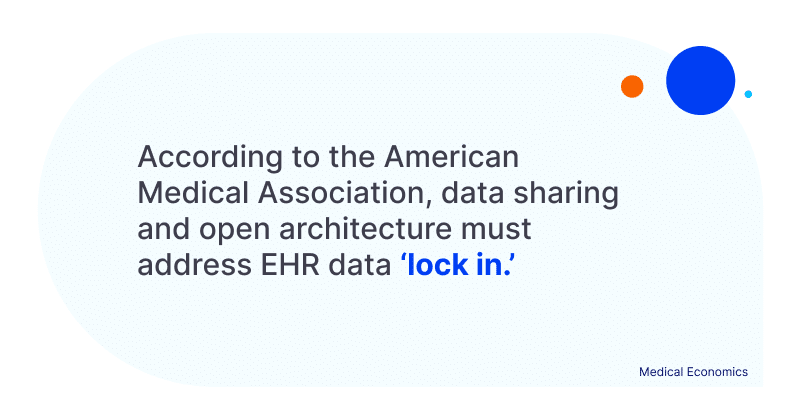
The AMA’s Improving Care report notes that “data sharing and open architecture must address EHR data lock in,” meaning organizations need infrastructure that can not only export data, but also properly incorporate external data into operational workflows.
That flexibility gives organizations more control over technology decisions because operational continuity no longer depends on staying inside one vendor ecosystem. Outcome: Organizations shift from dependency to control.
Enable Acquisition Strategies Without Technical Barriers
Acquisition integration also becomes more manageable when organizations are not forced to standardize systems immediately.
Instead of rebuilding revenue operations around a single EHR from day one, organizations can align operational and financial data while allowing clinical environments to evolve more gradually. Dix et al. show that this reduces disruption, speeds up reporting alignment, and lowers the operational burden that often slows post-acquisition integration. Outcome: Faster integration, more viable deals, and stronger growth strategy.
The point isn’t to eliminate complexity. The goal is to stop every technology change from turning into a revenue disruption event.
That’s what Universal Import is really solving. It’s not just helping systems connect. It creates the operational foundation that allows organizations to scale, transition systems, and integrate acquisitions without destabilizing financial performance.
Universal Import Creates the Foundation for Claims Portability
Rather than forcing organizations to rebuild revenue operations every time systems evolve, Universal Import creates a way to bring different environments together without breaking the workflows underneath them.
Universal Import Eliminates Integration Dependencies
A lot of the friction in multi-EHR environments comes from how tightly systems are connected.
One change upstream can suddenly force teams to rebuild integrations, adjust reporting logic, or manually reconnect workflows just to keep operations running normally. Growth slows down because every new system creates another dependency.
Universal Import changes that dynamic by allowing organizations to bring in data from different EHRs and operational systems without rebuilding the revenue cycle around each one. Expanding sites, inherited platforms, and specialty-specific tools become easier to absorb because the infrastructure underneath them is designed to handle variation.
This means organizations can:
- Import data from an EHR or operational system, regardless of file format (CSV, flat files, proprietary exports, and structured data)
- Handle format variation across client environments without building separate intake processes for each one
- Map incoming fields to a standard schema at ingestion
- Remove dependency on custom integrations and vendor-specific connectors
- Onboard new systems quickly without delaying revenue operations
- Reduce integration bottlenecks that slow growth and system change
Universal Import Creates Consistency Without Manual Overhead
Most fragmented environments don’t fail dramatically. They become exhausting over time.
Teams start checking numbers across multiple platforms, fixing mismatched records manually, and maintaining reporting workarounds nobody originally planned for. Eventually, entire workflows depend on staff knowing how to navigate around the gaps between systems.
Universal Import helps reduce that strain by standardizing incoming data automatically. Patient identifiers, billing codes, encounter data, and operational fields can all be aligned into a consistent structure. In response, teams spend less time cleaning up disconnected information and more time working from reporting they can trust.
The AI-powered mapping:
- Automatically matches fields across systems (patient IDs, codes, encounter data)
- Normalizes formats, fields, and definitions into a consistent structure
- Flags mismatches or missing data at ingestion
- Eliminates repeated mapping work
- Maintains consistency as systems evolve or change
Universal Import Scales Without Increasing Complexity
Universal Import reduces the rebuild work by allowing organizations to reuse standardized ingestion structures across different systems and data types. New environments can be brought online much faster because the operational logic underneath already exists.
Instead of creating entirely new processes for every change, organizations can maintain more consistency across reporting and workflows as they scale. For medical billing companies, this is especially valuable during client onboarding and client EHR transitions. Reusable templates mean new clients can be brought online faster, and a client switching EHRs doesn’t require rebuilding the entire data intake process from the ground up.
Template capabilities include:
- Save mapping logic as reusable templates per system or data type
- Apply templates to new imports without rebuilding mappings
- Maintain consistent structure across all data sources
- Reduce setup time for onboarding new systems
- Scale without increasing operational complexity
- Accelerate onboarding by applying templates to new client data environments
- Reduce operational lift when a client switches EHRs by reusing standardized mapping
Universal Import Unifies Fragmented Operations
One of the hardest parts of operating across multiple systems is understanding how activity in one part of the organization affects revenue somewhere else. When something starts slowing down or revenue performance changes, teams often spend days trying to trace the source of the problem across disconnected workflows.
Universal Import helps bring those operational signals into the same structure. Appointments, documentation activity, billing data, and revenue outcomes become easier to connect. That gives teams a clearer view of how the revenue cycle is really performing across the organization and what’s impacting revenue changes.
Universal Import:
- Combines clinical, scheduling, and billing data into one unified model
- Links upstream activity (appointments, documentation) to downstream outcomes (claims, revenue)
- Surfaces cause-and-effect relationships across workflows
- Reduces fragmentation between systems and teams
- Turns disconnected data into actionable insights
Turning this into a working model requires infrastructure built for flexibility. This is where platforms like CollaborateMD by EverHealth operationalize Universal Import—using AI-powered technology to ingest and standardize data from any EHR or operational system. For medical billing companies, that means a consistent, scalable foundation that doesn’t have to be rebuilt for every client or every EHR change.
This allows organizations to:
- Adapt to system changes without disruption
- Scale across multi-EHR environments
- Maintain consistent performance as complexity grows
Strategic Flexibility Turns Data Infrastructure into a Competitive Advantage
Healthcare technology environments are becoming more distributed, not less. Growing organizations are expanding across locations, integrating acquisitions, and operating across mixed system environments.
The organizations that adapt best won’t necessarily be the ones with the fewest systems. They’ll be the ones with infrastructure flexible enough to keep revenue operations stable while those systems continue evolving around them.
CMD’s Universal Import tool has proven to be a remarkable asset for our teams! Overnight, it paved a way to improving overall production with unparalleled accuracy and ease…saving us from the administrative burden of hours of manual data entry work.
That flexibility changes how organizations grow. Revenue performance becomes less vulnerable to migrations and system changes. Acquisitions become easier to integrate. Multi-EHR environments become more manageable without the same reporting fragmentation and operational overhead.
Most importantly, technology decisions stop revolving around compatibility constraints and disruption avoidance. Organizations can choose systems based on operational and clinical needs rather than whether the revenue cycle can survive the transition.
Revenue stays stable even as systems change. Transitions, migrations, and upgrades no longer disrupt performance. Growth is no longer constrained by technology compatibility. Acquisitions become easier to integrate and faster to realize value. Data moves freely across systems, removing vendor dependency.
This is the shift from fragmented operations to controlled performance. From reactive problem-solving to proactive revenue management. Universal Import isn’t about integration—it’s about control. Whether you’re a medical billing company managing revenue operations across a book of clients or a growing healthcare practice navigating multi-EHR complexity, Universal Import creates the infrastructure flexibility to scale without rebuilding. Schedule a demo today to see how CollaborateMD by EverHealth can simplify your data environment and reduce the operational lift that’s slowing you down.