
Revenue cycle challenges aren’t new for primary care practices, but they’re getting harder to manage. Denials are rising, and stricter payer rules and coding changes are putting revenue margins at risk.
Yet the most significant challenge isn’t complexity itself—it’s the lack of real-time visibility into what’s happening across the revenue cycle.
Many practices still rely on delayed reporting to identify problems like denial spikes, payer delays, or workflow inefficiencies. By the time practices discover these issues, performance and financial damage have already happened.
Medical billing analytics changes this dynamic by enabling real-time transparency into claims, denials, payments, and team performance. Instead of simply accessing data, practices can see what’s happening as it unfolds and act on it immediately.
The outcome is faster decision-making, reduced revenue leakage, improved operational efficiency, and stronger financial outcomes. This guide shows how medical billing analytics can improve revenue cycle performance and achieve financial stability, driving continuous improvement.
The Growing Complexity of Primary Care Revenue Cycle Management
Revenue cycle management in primary care keeps getting more complicated. Practices juggle high patient volumes, a mix of visit types, shifting coding requirements, and a blend of commercial, Medicare, and Medicaid payers, each with its own reimbursement rules and documentation demands.
At the same time, claim denials continue to rise across the healthcare industry. Prior authorizations alone have become a serious issue. An American Medical Association (AMA) survey found that 94% of physicians say prior authorization delays necessary care, and 93% reported negative effects on patient outcomes.
These pressures make it increasingly difficult for primary care practices to maintain financial stability while delivering efficient patient care.
While these challenges increase administrative complexity, the larger issue is that many practices lack the visibility needed to respond effectively. Most have access to plenty of data through EHRs, practice management systems, and payer portals. However, raw data access isn’t the same as operational visibility.
Revenue cycle information is often fragmented across multiple systems, unstructured, and delivered through delayed reports. Medical billing leaders can have access to dozens of metrics yet struggle to understand why denial rates are increasing, where claims are stalling, or which operational issues are affecting reimbursement.
This distinction between access and transparency is critical.
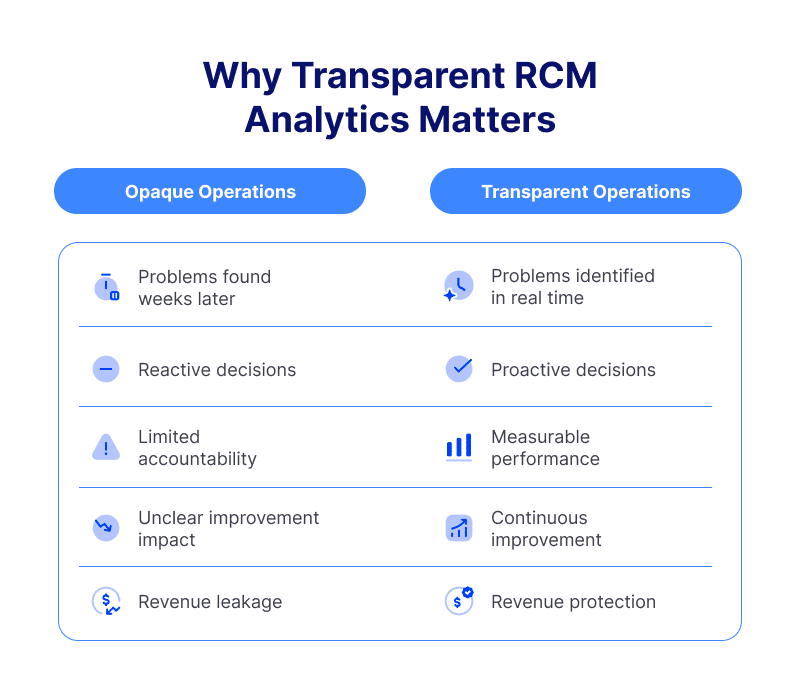
Access provides information after the fact. Transparency provides clear, timely insight that helps practices understand what’s happening across the revenue cycle as it unfolds. Without that visibility, even small operational issues can remain hidden until they become larger financial and administrative challenges.
The Core Problem: Limited Visibility Into Revenue Cycle Performance
When practices can’t see problems as they emerge, understand their causes, evaluate team performance, or measure the impact of operational changes, managing revenue cycle performance becomes increasingly difficult.
Medical Billing Problems Are Identified Too Late
A lot of practices still judge medical billing performance through periodic reports instead of ongoing monitoring. By the time a trend like rising denials, slower reimbursements, or coding issues becomes visible, it’s often already eaten into weeks of revenue.
Staffing pressures make this worse. Another AMA survey on prior authorizations found staff spending close to 13 hours a week dealing with this task alone, leaving little room to track medical billing performance or dig into emerging problems proactively. Small issues can sit there unnoticed until they turn into real financial setbacks.
That delay is costly. Denied claims need rework, resubmission, and follow-up, which piles on administrative work and stretches out reimbursement timelines. According to Physicians Practice, the damage can be significant since industry estimates suggest more than 60% of denied claims never get reworked at all, which means that revenue is simply lost.
By the time delayed reports reveal a growing denial trend or slowing reimbursements, the financial impact has often been building for weeks. The longer problems remain hidden, the more expensive and time-consuming they become to resolve.
Shift From Reactive to Proactive Revenue Cycle Reporting and Management
Medical billing analytics closes the RCM data visibility gap by replacing periodic reporting with continuous monitoring. Instead of waiting until the end of the month to review billing performance, leaders can track claim status, denial trends, reimbursement timelines, and payer activity as they evolve. Small changes become visible while they’re still manageable rather than after they’ve already affected weeks of revenue.
Continuous monitoring also enables faster intervention. A sudden increase in denials, an unexpected slowdown in reimbursements, or a change in payer behavior can be flagged early, allowing medical billing teams to investigate and respond before those issues grow into larger financial problems. Rather than spending weeks recovering lost revenue, practices can prevent many issues from escalating in the first place.
For most practices, that’s a genuine shift in how billing gets managed. It stops being something you look back on and becomes something you steer day to day.
Revenue Performance Is Hard to Diagnose
Detection of medical billing problems isn’t enough—you still need the cause.
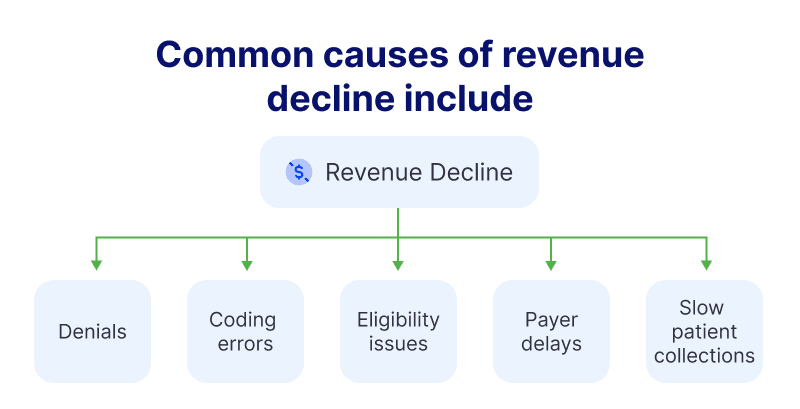
When revenue dips, finding the root cause isn’t straightforward. Denial rates, coding accuracy, payer behavior, and patient collections all factor in, and even experienced medical billing staff can struggle to isolate which one is driving a particular trend.
Without real-time visibility into those variables, teams end up guessing. A rise in accounts receivable might look like a collections problem at first. Run the analytics, and it may turn out that a specific payer quietly stretched out its reimbursement window.
Likewise, a jump in denials might not be a coding issue at all. It could trace back to registration errors or eligibility verification gaps.
Chasing the wrong problem wastes time and resources while the real issue keeps causing damage. Recovery stretches out longer than it should, and improvement initiatives end up delivering less than they promised.
Turn Data Into Revenue Cycle Intelligence
Medical billing analytics enables evaluation of denial patterns, payer behavior, coding trends, payment timelines, and workflow performance at a granular level. Leaders can determine whether problems are isolated to specific payers, services, providers, or operational processes.
This visibility accelerates root-cause identification and allows practices to implement more targeted solutions. Instead of guessing, teams can make decisions based on evidence.
The outcome is faster performance recovery. This means fewer weeks of underperforming reimbursement, less administrative rework, and more confidence that improvement efforts are addressing the real problem rather than its symptoms.
Limited Visibility Into Team Performance
Revenue cycle outcomes depend heavily on the people running medical billing operations day-to-day.
Yet many practices have a thin view of how individual team members are contributing to overall performance. Leaders might see aggregate denial rates or reimbursement totals without any real insight into the activities driving those numbers.
Without that performance visibility, coaching tends to be reactive and generic. A manager might notice denial rates climbing but have no way of knowing whether the cause is eligibility verification, coding mistakes, or slow follow-up on unpaid claims. So they roll out broad training initiatives even when only one area actually needs attention.
Meanwhile, the employee responsible for the issue continues using the same workflow, while high-performing team members spend time in training they didn’t need. The underlying problem persists despite the additional effort, delaying performance improvements and reducing the return on time invested in coaching.
Without accurate performance data, managers simply can’t intervene effectively. Over time, these blind spots chip away at operational efficiency, weaken accountability, and make it harder to improve medical billing performance in any lasting way.
Build High-Performing Revenue Cycle Teams
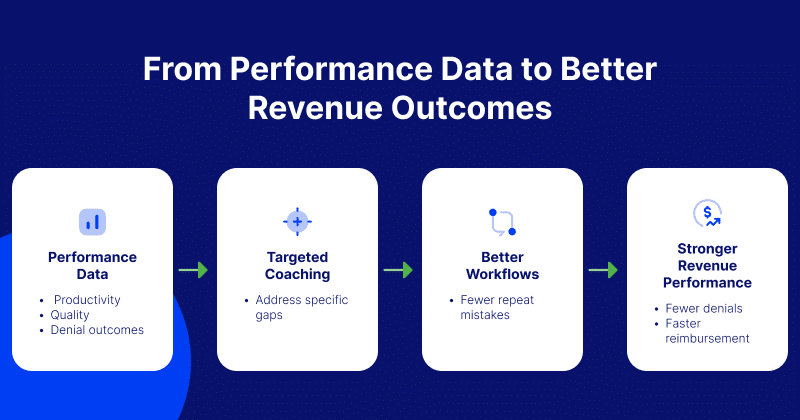
Medical billing analytics helps fix this by making performance visible at both the team and individual levels. Practices can track productivity, claim processing activity, denial management outcomes, and quality indicators, building a clearer picture of how work actually gets done and where the gaps are.
With that information in hand, coaching becomes more precise. Training needs surface earlier. Practices can spot and hold onto the people who consistently deliver strong results.
The payoff extends beyond better staff management. When coaching is guided by performance data, teams make fewer repeat mistakes, claims move through the revenue cycle more efficiently, and high-performing workflows become easier to replicate across the department. Over time, those incremental improvements contribute to lower denial rates, faster reimbursement, and more predictable financial performance.
Medical Billing Performance Improvement Efforts Aren’t Measured
Practices invest real money and time into fixing revenue cycle problems. New workflows get rolled out. Staff gets trained. Technology gets upgraded. What often doesn’t happen is any real effort to check whether any of it actually worked.
That’s not a minor gap.
Without clear before-and-after comparisons, a team can spend months on an initiative and see no real movement, with no way of knowing whether the approach was flawed or something else was quietly undermining it. On the flip side, a change that actually helped might get scrapped simply because nobody tracked the results.
For example, a practice might introduce new coding guidelines to reduce denials. If denial rates stay the same, it’s difficult to tell whether the training failed, adoption was inconsistent, or another issue is responsible. Without measurement, teams are left guessing what to fix next.
Industry guidance increasingly points practices toward continuous KPI monitoring and deliberate remeasurement after any operational change. But guidance and actual practice are two different things. Many medical billing teams just don’t have the infrastructure to measure change consistently, so improvement stays anecdotal instead of provable.
Create a Framework for Continuous Improvement
Medical billing operations analytics fills the gap by giving practices a reliable way to measure what they are doing and whether it’s working.
Establishing baseline metrics before making operational changes means results can be compared against something concrete rather than estimated. After a workflow adjustment or training initiative rolls out, performance data shows fairly quickly what moved, what did not, and by how much. That feedback loop becomes its own management tool over time.
Leaders develop a clearer sense of which interventions tend to produce results in their specific environment and which ones look good on paper but fail to move the metrics that matter. Resource allocation gets sharper. Accountability becomes easier to maintain because performance expectations are grounded in data rather than assumptions.
The cumulative effect is a medical billing operation that learns from itself, catches problems earlier, and trends steadily upward rather than lurching between crises.
Medical Billing Analytics Drives Faster Decision-Making
Transparency changes how revenue cycle decisions are made. Instead of waiting for monthly reports, leaders can monitor claim status, denial trends, payer behavior, and productivity metrics as they evolve.
This visibility reduces the delay between identifying a problem and taking corrective action. Teams spend less time gathering information and more time resolving issues. The result is faster, more confident decision-making that helps practices respond proactively rather than reactively.
Transparency Enables Continuous Improvement
Faster decisions improve performance in the short term, but lasting results require continuous improvement.
Medical billing analytics creates an ongoing feedback loop between action and outcome. Practices can evaluate performance before and after operational changes, allowing them to measure results with greater precision.
This capability helps transform improvement from an occasional initiative into an ongoing operational discipline. Teams can continuously refine workflows, strengthen processes, improve training programs, and optimize resource allocation based on measurable outcomes.
Over time, improvement becomes systematic rather than reactive, creating a more disciplined and data-driven approach to revenue cycle management.
Operational Agility Requires Transparency
The ultimate goal isn’t visibility but agility. As payer requirements, reimbursement models, and administrative demands continue to evolve, practices must adapt quickly to protect financial performance.
Medical billing analytics provides the transparency necessary to identify changes early, understand their impact, and respond effectively. Leaders can adjust workflows, reallocate resources, and implement targeted interventions before performance declines significantly.
This adaptability creates a substantial competitive advantage. Practices that continuously monitor and optimize revenue cycle performance are better positioned to reduce revenue leakage, maintain operational efficiency, and achieve long-term financial stability.
In this way, billing analytics becomes more than a reporting tool. It becomes the foundation for a more resilient and strategically managed revenue cycle.
Set Up the Medical Billing Analytics Infrastructure You’ll Need to Navigate Revenue Cycle Complexities
High-performing practices aren’t necessarily those facing fewer revenue cycle challenges. They’re the ones that can identify problems earlier, understand their causes faster, and respond before revenue is affected.
Transparency enables faster decision-making. Faster decisions support continuous improvement. Continuous improvement creates the operational agility needed to navigate an increasingly complex reimbursement environment.
Medical billing analytics makes this possible by transforming billing data into actionable operational intelligence. With greater visibility into claims, denials, payer performance, and team productivity, practices can reduce revenue leakage, improve accountability, and make more informed business decisions.
Platforms like CollaborateMD by EverHealth support transparency and visibility through medical billing analytics and reporting tools. The software helps practices monitor claim status, track denials, analyze payer trends, measure team performance, and identify opportunities to improve revenue cycle efficiency.
Talk to an expert to see how medical billing analytics can help your practice improve revenue performance.