
Maintaining consistency across high claim volumes is increasingly difficult for small and mid-sized practices. Staffing shortages, administrative complexity, and growing payer requirements have made manual medical billing operations more vulnerable to preventable errors and workflow breakdowns.
The financial impact is significant. Denied claims take significantly longer to reimburse, if they’re reimbursed at all. They also increase the administrative workload for medical billing teams.
At the same time, according to a 2025 Medical Group Management Association (MGMA) survey, 78% of medical practice leaders report increased stress levels tied to operational and financial pressures. As claim volume rises, even small inconsistencies in coding, eligibility verification, documentation, or follow-up can create costly downstream delays.
This is where medical billing automation delivers its greatest value.
While healthcare automation is often associated with speed, its more meaningful impact is operational reliability. Automated medical billing helps practices execute routine billing tasks consistently, reducing preventable denials, improving claim accuracy, and creating more predictable revenue cycle performance.
This guide covers how, rather than functioning as a technology upgrade alone, medical billing automation serves as an operational infrastructure that supports scalable, dependable financial operations.
Inconsistent Manual Medical Billing Processes Create Preventable Errors and Revenue Leakage
Medical billing teams run through the same handful of tasks hundreds of times a week: verifying eligibility, reviewing codes, checking documentation, and confirming payer requirements. None of it is complicated in isolation. The challenge is doing it correctly every single time.
Manual workflows are only as reliable as the people running them, and people get pulled in five directions at once when volume spikes. Staying error-free and consistent is a lot to ask under those conditions.
It doesn’t take much to turn a routine claim into a problem. One missed eligibility check, one missing attachment, one coding slip, and suddenly a claim that should have sailed through needs correction, resubmission, and another round of staff time to sort out.
What’s frustrating is that these aren’t mysterious failures. Teams usually know exactly where their workflow weak points are. Knowing isn’t the same as preventing, especially when everyone’s stretched thin, and the clock is always running.
Left unaddressed, this pattern worsens. Medical billing staff ends up spending more hours fixing claims that should have gone through the first time, reimbursement timelines get harder to predict, and the cost of revenue cycle management creeps upward.
How Automated Medical Billing Reduces Preventable Billing Errors
Automated medical billing workflows reduce these operational gaps by standardizing routine execution.
- Eligibility verification can occur automatically at claim initiation.
- Real-time coding validation can flag incomplete or incorrect claims before submission.
- Documentation requirement checks help ensure required attachments are included systematically rather than inconsistently.
- Automated follow-up workflows also ensure unpaid claims receive attention within predefined timelines instead of relying entirely on manual tracking.
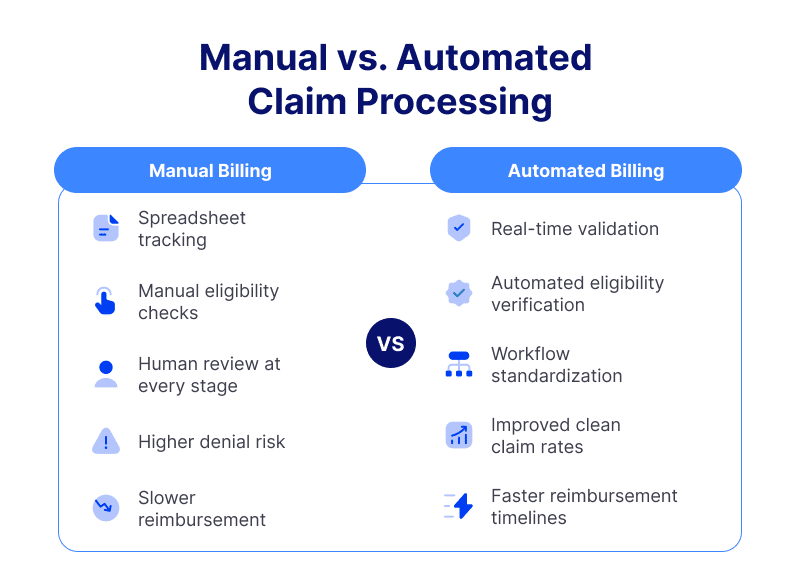
The operational value of automation is consistency—and consistency has a direct financial payoff.
Fewer preventable errors lead to higher clean claim rates and improved first-pass acceptance rates. Medical billing staff spend less time on rework and denial management. Reimbursement timelines become more predictable because claims are submitted more accurately from the start.
The bigger shift is philosophical: medical billing quality stops being a function of who’s on staff that day and becomes a function of the process itself. That’s a steadier foundation to build revenue cycle performance on, especially when staffing fluctuates or volume keeps climbing.
Workflow Variability Creates Inconsistent Performance
Even with the same medical billing system and general procedures, workflows vary from employee to employee. Some follow up on pending claims within 15 days; others wait 30. Some apply modifier logic correctly; others approximate. All of this differs based on individual habits, experience levels, and workload demands.
These variations create inconsistent operational performance. Two nearly identical claims can be treated differently depending on who handles them. Reimbursement outcomes become harder to predict, and managers lose the ability to hold the whole team to a consistent standard.
Once performance varies this much, it’s genuinely hard to measure, improve, or scale. Training helps at the margins, but it rarely closes the gap entirely, and the problem only gets harder as a practice grows, onboards new hires, or deals with turnover.
Eventually, success starts riding on individual work styles rather than a standardized process, which makes consistent performance tough to deliver.
How Automated Medical Billing Workflows Standardize Execution
Healthcare automation helps practices establish standardized medical billing workflows that execute according to predefined rules rather than individual preferences.
- Automated follow-up schedules ensure claims receive attention at consistent intervals.
- Rule-based workflows apply the same claim preparation and documentation standards across all submissions.
- Standardized routing processes ensure tasks move through the billing cycle consistently.
- Automated workflow tracking provides visibility into process compliance.
By creating repeatable workflows, practices reduce variation between employees and departments. Medical billing performance becomes easier to monitor because every claim follows the same operational framework.
Consistency also improves onboarding and workforce flexibility. New team members can follow established workflows more easily, while managers gain greater confidence that billing standards are being maintained.
Manual Medical Billing Operations Create Staffing Constraints as Claim Volume Increases
For many growing practices, increasing patient volume creates additional administrative pressure across medical billing operations. Claim submission, follow-up activity, denial management, and payment posting workloads all expand alongside reimbursement demands.
In manual medical billing environments, operational growth often requires proportional staffing growth to keep pace. This creates a difficult position for small and mid-sized practices. Hiring additional medical billing staff increases overhead before new revenue is fully realized, while delaying operational expansion can lead to claim backlogs, slower follow-up activity, reimbursement delays, and greater billing inconsistency.
The challenge is compounded by ongoing staffing pressure across healthcare operations. Medical practices continue to face high levels of employee stress, turnover, and administrative burnout, making it increasingly difficult to scale through hiring alone. A May 2026 MGMA survey found that 29% of medical groups are experiencing higher staff turnover this year compared to 2025.
How Automated Medical Billing Enables Practices to Scale Without Proportional Staffing Growth
Billing automation changes this operational model by reducing the amount of human effort required for routine claim processing.
Automated medical billing workflows can manage repetitive administrative tasks systematically while routing only exceptions or higher-complexity claims to staff members for review. Automated follow-up sequences can also track unpaid claims without relying on manual reminders or spreadsheets.
This allows existing medical billing teams to manage higher claim volume without proportional increases in staffing requirements. Instead of expanding headcount at every stage of growth, practices can increase capacity while maintaining tighter control over billing overhead.
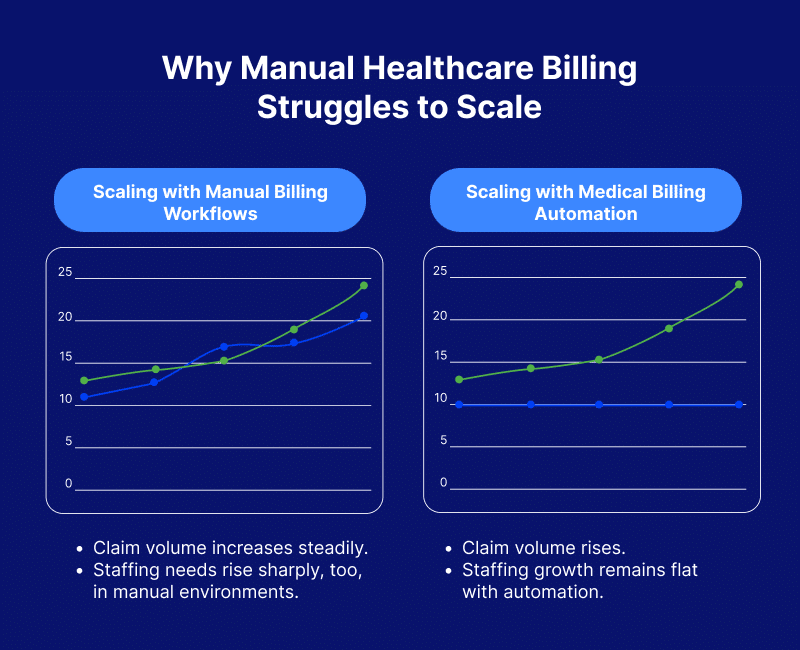
For smaller practices, this is a meaningful shift. The kind of healthcare billing consistency and capacity that used to require a much larger administrative team is now within reach for practices that don’t have one. Automation hands smaller groups the same operational leverage that larger systems built through sheer headcount.
The financial upside extends past labor savings alone. Medical billing costs grow more slowly than revenue does, which improves operational leverage as a practice scales. Teams spend less time grinding through repetitive tasks and more time on the things that actually move reimbursement and patient experience forward.
Overall, billing operations become more predictable, more resilient, and better equipped to support growth without creating the same administrative strain that accompanies fully manual processes.
Limited Visibility Into Medical Billing Performance Delays Revenue Cycle Intervention
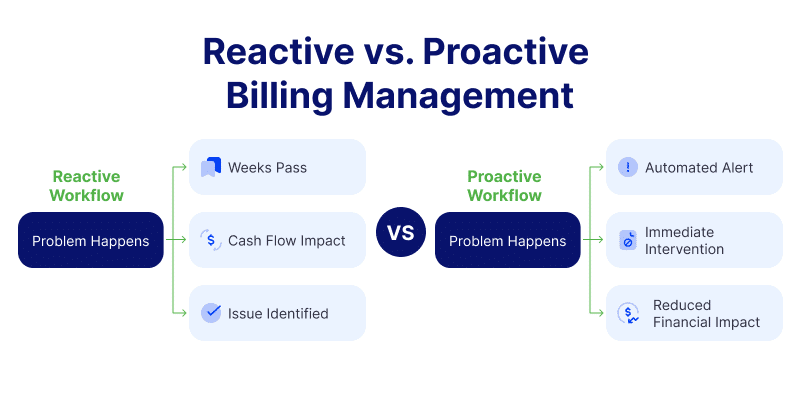
In manual medical billing environments, operational issues often become visible only after reimbursement slows, denial rates increase, or month-end reporting reveals financial inconsistencies. By then, problematic workflows may have already affected hundreds of claims.
This lack of visibility creates a reactive operational model. Billing managers frequently spend time identifying problems after revenue disruption has already occurred rather than preventing issues earlier in the workflow.
Manual reporting processes also limit how quickly practices can respond to emerging billing issues. Teams often rely on spreadsheets, periodic reporting, or manual claim reviews to identify operational trends. This delays intervention and increases the likelihood that workflow inefficiencies continue to impact reimbursement performance across multiple billing cycles.
How Proactive Management and Visibility Minimize Medical Billing Problems
Medical billing automation replaces the periodic snapshot with something closer to continuous awareness. Real-time dashboards can track denial trends, claim aging, reimbursement timelines, and follow-up activity as they’re happening, not weeks later.
Automated alerts can flag a denial rate creeping upward, a claim that’s gone unresolved past a set threshold, or a payer issue that’s starting to affect collections, often before it shows up in a monthly report at all.
This allows practices to shift from reactive medical billing management to proactive operational oversight. Instead of discovering problems weeks later through cash flow disruptions or reporting reviews, teams can identify workflow issues earlier and intervene before they escalate into larger financial problems.
Continuous visibility also improves management confidence because billing performance becomes easier to measure, monitor, and optimize over time. Workflow performance can be evaluated systematically rather than anecdotally, helping practices identify recurring operational gaps and improve process execution more consistently.
Most importantly, earlier intervention reduces the financial impact of medical billing inefficiencies. Problems are addressed while still manageable, helping practices maintain more stable reimbursement performance and stronger revenue cycle predictability.
Reliable Medical Billing Operations Require Reliable Systems
As medical billing operations become more complex, maintaining consistent financial performance through fully manual workflows is getting difficult. Small process variations in coding, eligibility verification, documentation, and follow-up can create preventable denials, reimbursement delays, and a growing administrative burden that affect long-term revenue cycle stability.
Medical billing automation helps practices reduce these operational gaps by creating more consistent, scalable, and visible billing workflows. Automated eligibility checks, coding validation, documentation reviews, and follow-up processes improve claim accuracy while reducing reliance on manual oversight and repetitive administrative work.
The result is more reliable billing performance, improved reimbursement predictability, and stronger operational scalability as practices grow.
CollaborateMD by EverHealth provides automated medical billing workflows, real-time operational visibility, and revenue cycle management capabilities designed to improve consistency across medical billing operations. Talk to an expert to learn how you can improve your medical billing workflows with CollaborateMD.