
Most medical billing teams are busy. The question is whether they’re busy in the right place. Across the healthcare industry, denials are common and rising. According to a Medical Group Management Association (MGMA) Stat poll, 60% of medical groups surveyed said claim denials increased from 2023 to 2024. The top reasons for denial—insufficient documentation, patient eligibility, incorrect ID numbers, and untimely filing—all can be remedied with a more proactive approach.
Denial management in healthcare is necessary, but it’s usually a recovery effort that begins only after revenue is already at risk. Denial prevention addresses the problem before a claim is ever submitted. This guide makes the case that prevention is the superior resource-allocation strategy and shows medical billing leaders how to shift efforts from managing denials to preventing them from happening in the first place. Fewer denials are the goal of every practice because reducing them translates to lower labor costs, less rework for medical billing teams, and a more predictable revenue cycle.
The Difference Between Managing and Preventing Medical Claim Denials
Medical claim denial management is, by its nature, reactive. It begins after a claim is denied and focuses on recovering revenue through rework. The problem with denial management is that the cost, both in lost claims and in time spent on resubmissions, is high.
Claim denial prevention, on the other hand, is proactive. It addresses the issues that cause denials before the claim is submitted.
Managing denials reactively comes with several pitfalls. Let’s explore the most common ones and how shifting to proactive denial prevention fixes these pitfalls.
Too Much Time Is Spent on Appeals Instead of Claim Denial Prevention
Medical billing teams spend a large portion of their time working on denials. This includes researching issues, submitting appeals, and following up with payers. And data suggests this will only get worse.
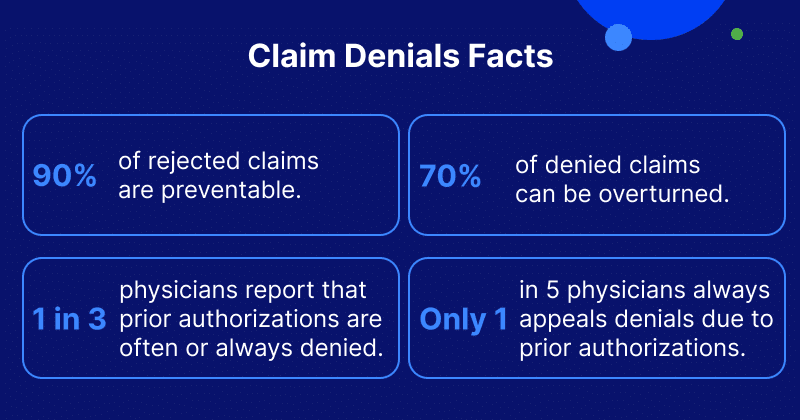
The American Medical Association’s 2025 Prior Authorization Physician Survey shows that medical claim denials are increasing. One in three physicians reports that prior authorizations (PA) are often or always denied, and 74% claim PA denials have increased over the last five years. Only 20% of physicians always appeal these denials, and those who do work on denials do so reactively.
By the time a claim is denied, the problem has already happened. Fixing the problem at this stage is slower and less reliable than getting it right up front. In this cycle, your team remains trapped in the busy process of recovering revenue instead of preventing losses in the first place.
Move the Work Upstream and Catch Issues Before Submission
To solve this pitfall, shift your focus from appeals to preventing denials before submission by addressing risk factors. Does your practice have a process for ensuring patient information is correct before submitting a claim? Do you automate routine tasks like insurance verification and claim scrubbing to catch issues before submitting?
Practices that move the work upstream end up with fewer denials to manage in the first place. They spend less time on rework and appeals, and as a result, they achieve more predictable and efficient revenue cycle performance.
The Same Claim Denials Keep Happening
Most practices see the same denial reasons over and over. They typically consist of coding issues, missing information, and authorization gaps. Even teams with strong denial management experience persistent problems. They handle the issues one claim at a time instead of fixing the root of the problem. And without addressing root causes, denial volume doesn’t meaningfully decline. Teams just learn how to manage the same volume more efficiently.
Fix the Root Cause, Not One Claim at a Time
Start analyzing denial trends to identify recurring issues, then fix upstream workflows that are causing repeat denials. Is it usually coding errors, eligibility issues, or incomplete documentation? Are some of your denials due to frequent payer changes that your practice is having trouble staying up to date with? You can use denial data to drive process improvements, not just reporting.
Practices that focus on fixing the root causes of claims will see their denial rates decrease over time instead of staying flat. They’ll spend less effort managing repeat issues and achieve a higher first-pass claim accuracy.
Claim Denial Appeals Deliver Lower Returns than Prevention
A meaningful percentage of denied claims are never paid, despite the time spent pursuing them. In the AMA report cited earlier, 59% of physicians who don’t appeal say they don’t because they don’t believe the appeal will be successful based on past experience. And 52% report they have insufficient practice staff resources or time.
Even successful appeals carry a cost. As Physicians Practice reports, it costs over $25 to rework a claim, based on industry reports from Medical Group Management Association (MGMA), PNC Financial Services, Centers for Medicare & Medicaid Services (CMS), The Advisory Board Company, and the Healthcare Financial Management Association (HFMA). This is more proof that allocating resources toward reactive management is not an effective ROI strategy.
Let’s look at prevention in contrast. Medical claims that are clean at submission are far more likely to be paid in full. This is one of the reasons that MGMA recommends that practices aim for a 95-97% or higher clean claim rate. However, the current average is 92%, and 60% of medical group leaders reported an increase in denials from 2024 to 2025, which indicates this problem is getting worse.
Closing that gap between recommended clean claim rates and the actual average requires a strategic resource allocation decision. But it’s a decision based on ROI, since prevention avoids losses almost entirely, while appeals recover only part of what’s already been lost.
Reallocate Effort Toward First-Pass Success
The first step to reallocating effort is to start measuring appeal success rates, then compare them to prevention efforts. Once you have this data, you can reallocate time toward activities that improve first-pass success and invest in processes that reduce the need for appeals altogether.
Practices that reallocate toward first-pass success achieve higher revenue per hour of staff effort, fewer frustrating, low-yield appeals, and a stronger overall financial performance.
Strong Processes for Managing Claim Denials—Weak Ones for Preventing Them
Most medical billing teams have well-defined processes for handling denials, including queues, workflows, tracking, and reporting. The same can’t be said for their prevention processes aimed at reducing denial claims. These processes often depend on individual effort rather than consistent systems designed for efficiency. Even when practices know that prevention is more effective, this process imbalance keeps them stuck in reactive mode.
Make Preventing Medical Billing Denials Core Infrastructure
The solution here is to treat denial prevention as a core operational priority. Build structured workflows focused on pre-submission accuracy and invest in tools and processes that support prevention. With strong processes, practices will generate fewer denials, reduce their reliance on appeals workflows, and shift from reactive to proactive revenue cycle management.
How to Shift Resources from Denial Management to Prevention
Making the shift from reactive to proactive involves two moves. The first is deciding where your resources will deliver the most return, and the second is putting prevention into practice with operational rigor.
Decide Where Your Resources Will Deliver the Most Return
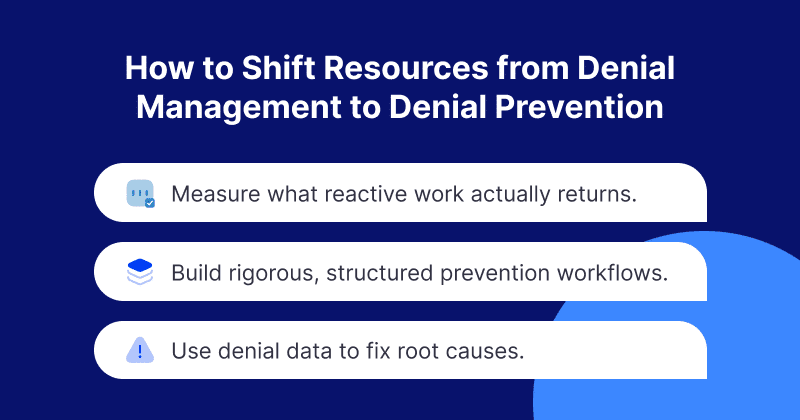
Start by measuring what your reactive work actually returns. Track your appeal success rate alongside the staff time each appeal consumes, then compare that yield to the cost of preventing the same denials upfront.
That comparison tells you where to redirect time, hours, and budget. In most practices, the hours currently spent researching and resubmitting low-yield appeals deliver less return than the same hours invested in first-pass accuracy. Redirecting even a portion of that capacity toward prevention is the strategic choice with the highest ROI.
Put Proactive Medical Billing Strategies into Practice
Once you’ve decided where to invest, treat prevention with the same operational rigor you already apply to denials. Build structured pre-submission processes, including eligibility verification at intake, automated claim scrubbing against payer-specific rules, and coding review before claims go out.
Then, close the loop by using denial data to drive process change, not just reporting. Feeding recurring denial trends back into these upstream workflows turns prevention from a one-time fix into a durable reduction in denial volume.
Prevent More, Manage Less with Strategic Claim Denial Reductions
Denial management will always be part of the revenue cycle work, but it shouldn’t be the priority. Denials are common, recovery rates are low, and every reworked claim costs money, but prevention flips the equation by protecting revenue before it’s ever at risk.
CollaborateMD by EverHealth is built to help you make that shift. With real-time eligibility verification, automated claim scrubbing, and denial analytics that pinpoint root causes, our practice management and medical billing platform helps you catch issues before they cost you anything to fix. Talk to an expert today and learn how to stop spending your team’s hours chasing recovery and start protecting your revenue at the source.