
Laboratory billing carries more weight than most healthcare teams realize. As research by Arizton shows, lab results inform 75% of medical decisions, but the billing behind them is under constant pressure. You’re processing high volumes, working with tight margins, and dealing with payer rules that keep shifting.
The challenge isn’t just complexity. It’s consistency. Requirements vary, documentation must prove medical necessity, and small gaps can slow reimbursement. And while denials are part of the process, the real issue is keeping accounts receivable moving without constant disruption.
In a reactive setup, problems only get addressed after submission. The same errors repeat, delays build, and your team spends more time fixing issues than improving how billing actually works. Meanwhile, it’s harder to see what’s really driving performance.
The first step to improving medical billing is getting control. Tighten data at intake, validate claims before submission, and track denial patterns so issues don’t keep repeating. From there, shift upstream. Identify problems earlier, act on them faster, and reduce the need for rework.
With the right systems in place, billing becomes easier to manage, more predictable, and far less dependent on firefighting.
Why Medical Billing for Laboratories Is Different
Laboratory billing doesn’t behave like physician billing. You’re not billing for time or visits. You’re pushing through large volumes of low-value claims, all under tight payer rules.
High-Volume, Low Margin Medical Billing
In most lab environments, volume is the game. You’re processing a huge number of tests every day, often for routine services that don’t carry much reimbursement on their own.
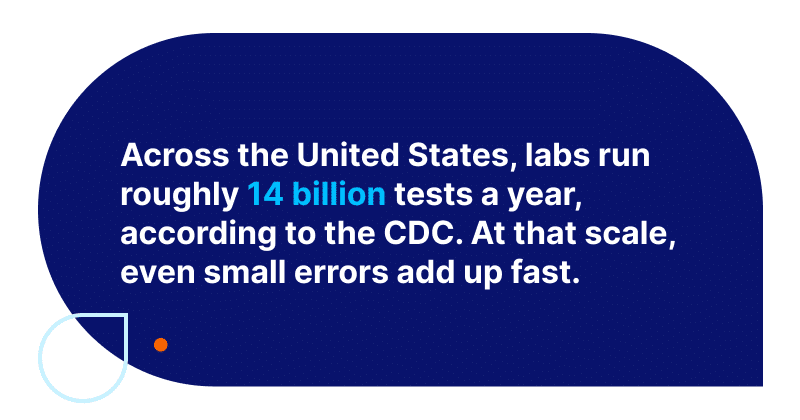
Margins don’t give you much room to absorb errors. If a coding issue or documentation gap shows up across hundreds or thousands of claims, you feel it.
That’s why accuracy is so important. Every test has to be coded correctly, tied to the right diagnosis, and submitted in line with payer rules. With hundreds of possible codes in play, keeping that level of precision consistent is one of the hardest parts of lab billing.
Changes to Coding and Payer Rules
Laboratory billing isn’t static. Codes evolve, new tests are introduced, and payers update their requirements regularly. Take the 2026 CPT update, for example. Hundreds of codes were added, removed, or revised, with lab and genetic testing making up a large share of those changes.
To add to the complexity, each payer applies its own layer of rules. Coverage, documentation, and reimbursement criteria can all vary, even for the same test. So setting up processes for payer rules and billing codes isn’t something you check once and move on from. It’s something you have to keep up with constantly. If workflows aren’t updated or teams fall behind, denials start to creep in.
Unique Denial Patterns
You’re not just billing for a service with lab billing. You’re proving that each test was necessary and supported by the right documentation. That puts a lot of weight on coding and how clearly the diagnosis connects to the test. If that link isn’t solid, claims get flagged.
You’re also dealing with both pre- and post-payment audits. That can mean delays before payment even arrives, or clawbacks after it’s already been posted.
Payer systems now also scan claims at scale. This means that small inconsistencies get picked up across thousands of claims at once. And because labs aren’t offsetting this with higher-value visits, there’s no cushion. When denials increase, the impact shows up quickly in cash flow.
For lab billing, this means staying ahead of issues matters just as much as fixing them.
Reactive Billing Impacts Financial Stability
Most labs rely on reactive billing. A claim gets denied, a payment stalls, or an audit flag shows up, and only then does someone step in to fix it.
It works until volume catches up with you. Over time, things get harder to track. Payments become less predictable, compliance risks creep in, and lab billing teams spend more time fixing problems than improving how the revenue cycle runs. You’re always reacting to what just happened, not what’s coming next.
Claim Accuracy and Administrative Errors
Most billing issues don’t start at submission. They start earlier, when patient details, orders, and insurance data are first captured.
In a reactive setup, those early checks aren’t always consistent. Details get entered incorrectly, eligibility isn’t verified in real time, and orders don’t always line up cleanly with payer rules.
The claim still goes out, but the problem is already baked in.
Lab billing adds another layer of complexity. Coding and bundling rules can be unforgiving. A test might be valid on its own, but it’s denied when grouped incorrectly. Different payers handle those rules differently, which makes creating consistent processes more difficult.
By the time the issue shows up, it’s already downstream. Now someone must stop, investigate, fix it, and resubmit. That slows everything down.
The Cost of Denials, Delays, and Resubmitting Claims
In a reactive model, denials get handled one by one. A claim is rejected, corrected, and sent back. But the underlying reason for constant denials is never solved, so the same issue keeps coming back.
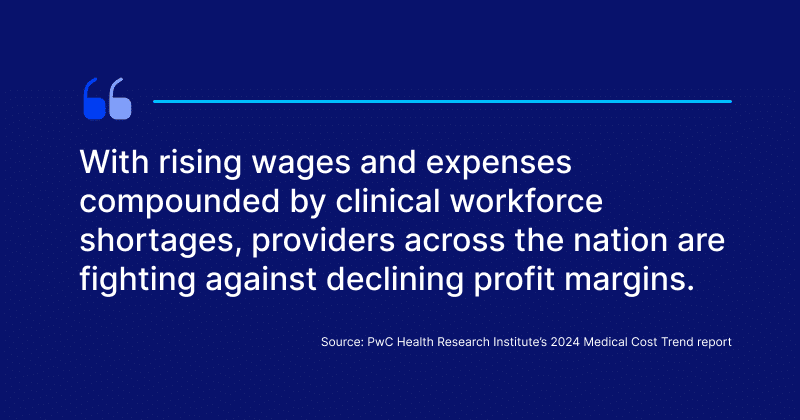
Payers also control the pace. As research by Chanderwarker et al shows, these multi-step workflows extend the time payers retain funds before payment is released. That keeps cash flow on their side, not yours.
Without early visibility into claim status and denial trends, the revenue cycle moves more slowly, costs more to operate, and delivers less predictable outcomes.
Narrow Margins and Rising Operational Pressure
Because reimbursement per test is low, revenue stability depends on volume and consistency.
Meanwhile, medical costs are going up. Staffing, equipment, and technology costs all add pressure.
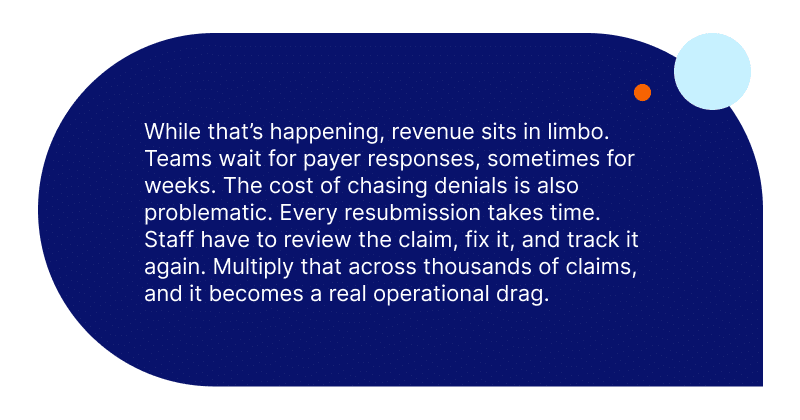
Even when revenue grows, costs tend to grow with it. So when claims are delayed or denied, you feel it straight away. Reactive billing makes that worse. Every correction and follow-up increases the cost per claim. It’s not always obvious at first, but over time, it chips away at profitability.
To stay stable, labs have to keep things moving. When billing slows down, everything else feels it.
Audit Risk and the Complexity of Staying Compliant
Rules frequently change in lab medical billing, making it challenging to keep up with regulations and stay compliant.
As Gayane Haroutyunyan of LigoLab explains, “The biggest challenge that laboratories face is compliance regulations that are ever-changing […]Keeping up to date with them is difficult for both small and large-scale laboratories.”
Federal oversight reflects this pressure. The Office of Inspector General Work Plan (2024–2026) includes ongoing audits of laboratory billing, reviewing whether claims meet federal payment limits and compliance rules. To add to this, Centers for Medicare & Medicaid Services (CMS) coverage policies require a clear link between the test, the diagnosis, and how often that test is performed. If that link isn’t documented properly, the claim doesn’t get paid.
Volume makes this harder. Repeat testing patterns are easier for payer systems to analyze, which means inconsistencies are easier to spot. That leads to pre-payment reviews that delay reimbursement and post-payment audits that can claw money back.
Compliance also extends beyond billing rules. Labs also have to meet HIPAA, CLIA, and CAP requirements at the same time. That’s multiple layers of compliance, across multiple payers, all moving at once.
In a reactive setup, compliance turns into firefighting. Problems get dealt with when they’re flagged, which is usually when they’re most expensive.
Staff Burnout
High volumes and complex rules create a constant stream of tasks for billing teams. They’re fixing errors, chasing denials, and resubmitting claims all the time. The extra work doesn’t really stop.
That workload is already stretching teams. If billing stays reactive, that workload doesn’t ease. It loops. The same issues keep coming back, and the team keeps dealing with them.
Over time, this can lead to staff turnover. Knowledge goes with them. And the pressure shifts onto whoever is left.
Lost Opportunities
When you’re stuck reacting, you have little opportunity to reflect on past issues. Teams focus on getting claims through, not on understanding why things are breaking. Patterns in denials, payer behavior, and reimbursement gaps are harder to see.
Without visibility, those patterns keep repeating. Recovery gets more expensive, and opportunities to improve performance get missed.
At that point, fixing individual claims isn’t enough. You need to change how billing is handled altogether.
Practical Steps to Stabilize Laboratory Billing Performance
Before moving to a proactive model, laboratories need to stabilize core billing processes and reduce immediate risk.
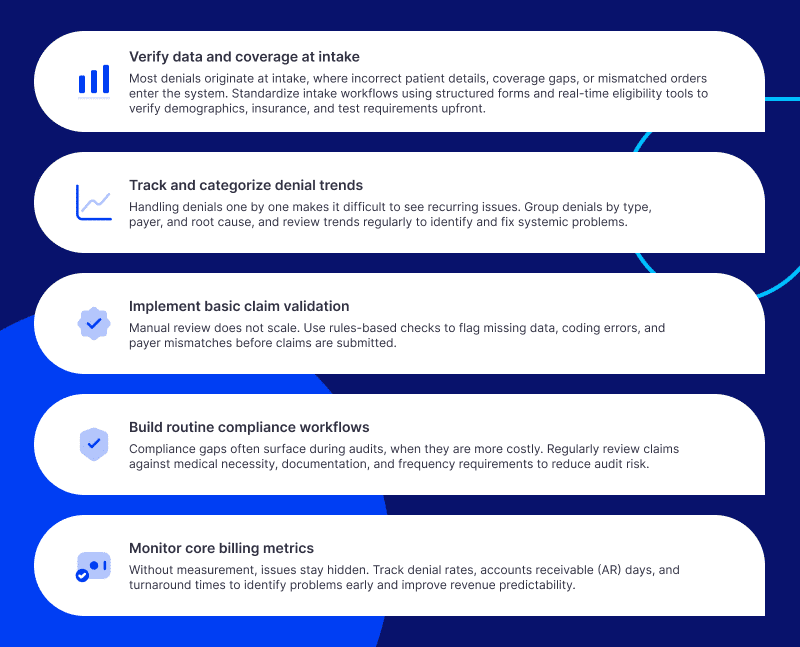
These steps stabilize billing performance and create the foundation for a proactive, predictable revenue cycle.
Shifting from a Reactive to a Proactive Approach to Medical Billing
Most lab billing teams start out reactive. The problem is that that approach doesn’t scale.
In a proactive model, the work shifts earlier. Issues are caught before submission, patterns are tracked as they happen, and decisions are made with a clear view of performance. The goal isn’t to eliminate denials entirely; it’s to keep accounts receivable moving and avoid repeated disruption. Here’s what your lab can do to make that happen:
Make Financial Transparency a Priority
In many lab environments, visibility comes too late. Teams only get a clear picture once claims are denied or payments stall. By then, the damage is already done.
Real-time visibility changes that. When you can see which claims are pending, where denials are coming from, and how reimbursement compares to expectations, patterns start to show up. This proactive approach allows you to act early instead of chasing issues later.
There’s also growing pressure to make this information more accessible. Regulations like the Clinical Laboratory Price Transparency Act of 2023 push labs to publish pricing. A 2026 poll by PatientRightsAdvocate.org (PRA) also reports that 96% of Americans say they want to know the price of their healthcare before receiving it.
That shift toward transparency doesn’t stop at pricing. The same expectation for visibility applies internally. When teams can see approval rates, reimbursement gaps, and denial trends in real time, they gain the visibility to spot issues earlier and keep claims moving.
Build Compliance and Data Privacy into Daily Operations
In a reactive setup, compliance tends to show up during audits. Claims get reviewed after something goes wrong, usually under time pressure. That’s when things are most expensive to fix.
A proactive approach pushes those checks earlier. Documentation is validated as claims are created, and payer rules are applied consistently.
Data privacy adds another layer of difficulty. Teams need access to process claims, but patient information still has to be protected. When compliance is built into the workflow with clear data governance, it stops being a scramble. Audits become easier to handle because the work is already aligned, data is protected by default, and risk is reduced before it shows up.
Use Automation to Support High-Volume Billing
Scale makes manual processes difficult to sustain. As volumes increase, so does the likelihood of inconsistencies. Different people review claims differently, things get missed, and errors start to repeat.
Automation brings consistency to lab billing. Rules apply the same way every time, flagging missing data, coding issues, and payer mismatches before claims go out. With automation in place, teams can focus on exceptions instead of reviewing every claim from scratch. Time can be optimized while simultaneously improving accuracy
Strengthen Data Accuracy at the Point of Entry
Mistakes early in the process are more expensive to fix later. If patient details are off, documentation is incomplete, or orders don’t line up with payer rules, the claim is already at risk.
In a proactive model, those checks happen upfront. Intake processes are consistent, and claims are built on complete, accurate information from the start. Medical billing software that flags potential errors or gaps and standardizes intake can help here.
That matters more in lab billing because there’s no consultation to anchor the claim. Everything depends on the data being right. When accuracy is handled early, there’s less to fix later. Claims move faster, and teams spend less time on rework.
Track Billing Performance Continuously
In reactive environments, performance is reviewed after the fact. But by then, it’s already impacting revenue. Continuous tracking solves this issue. When denial rates, AR days, and turnaround times are visible in real time, trends show up earlier.
That gives teams a chance to adjust before issues build up. If denial rates spike, the billing team can look into the cause before denials become unmanageable. If days in AR start trending upward, teams can reach out to payers to push faster payments or resolve potential delays.
With continuous tracking, patterns in payer behavior become clearer, and bottlenecks are easier to address. Over time, billing becomes more controlled. There’s less variability, forecasting improves, and performance is easier to manage.
Moving from reactive to proactive billing doesn’t eliminate complexity, but it makes it manageable. The result is a revenue cycle that’s easier to control, more predictable, and better able to support growth at scale.
Turning Laboratory Billing into a Scalable System
At scale, laboratory billing can’t rely on manual processes or disconnected tools. High volumes, complex payer rules, and tight margins don’t leave much room for inconsistency.
This is where technology starts to matter. Not just to process claims, but to bring structure and control to the entire revenue cycle.
Automated Charge Capture to Reduce Revenue Leakage
Automation is great for speeding up tasks. But it also makes sure work gets done the same way every time.
In lab billing, that starts with charge capture. Every test needs to be turned into a billable service. When that process is manual, things get missed, and those losses aren’t always obvious. Automated charge capture ties billing directly to test orders and results, so nothing slips through. Claims can then move out faster, often within hours of completion, which helps keep cash flow moving.
Platforms like CollaborateMD by EverHealth support this by automating charge capture, claim submission, and payment posting through electronic remittance workflows.
Validation that Prevents Denials and Supports Compliance
In lab billing, small inconsistencies repeat across large volumes of claims. That’s why validation has to happen before submission. Claim scrubbing, coding checks, and payer-specific rules help make sure each claim meets medical necessity and documentation requirements upfront.
Real-time eligibility checks add another layer, confirming coverage and frequency limits before a claim is even created. This step reduces preventable denials and limits rework later on.
CollaborateMD, for example, applies these checks within the billing workflow, using real-time validation and payer-specific edits to help keep claims accurate and compliant.
Integration that Improves Accuracy at the Source
Billing accuracy depends on the quality of data entering the system. When LIS, EHR, and billing systems don’t connect properly, errors show up early and only get caught later. That leads to mismatches, rework, and more denials.
Integration fixes that by letting patient details, test orders, and results flow directly into billing. That means fewer manual touchpoints, fewer opportunities for data entry mistakes, and better alignment between clinical and billing information.
It also helps ensure that documentation supports the claim from the start, especially when linking tests to diagnoses. That reduces back-and-forth later in the process.
CollaborateMD integrates with LIS and EHR systems to support this flow and reduce manual intervention.
Reporting that Supports Continuous Performance Improvement
Solid analytics also allow you to identify patterns. You can see which payers are slowing things down, where denials are increasing, and which workflows need attention. Rather than guessing where to improve your processes, teams can focus on what’s actually impacting performance and take action before issues scale.
CollaborateMD provides reporting and dashboards that give teams a clear, up-to-date view of billing activity and performance.
Support that Extends Beyond Implementation
Technology alone doesn’t solve billing challenges. Teams still need support to set up workflows, adapt to payer changes, and keep improving over time.
That’s especially true in lab billing, where rules shift, and processes need to stay aligned. Without ongoing support, systems can drift, and performance starts to slip. Strong support helps teams stay consistent, troubleshoot issues quickly, and refine how billing is handled as volumes grow or requirements change.
CollaborateMD includes onboarding, training, and ongoing support, so teams have guidance beyond implementation and can continue improving performance over time.
Medical Billing for Laboratories: Building Stability with the Right Technology
Laboratory billing operates under constant pressure, high volumes, complex rules, and little margin for error. When processes are reactive, small issues turn into delays, rework, and unpredictable cash flow.
The solution comes down to financial control.
With the right systems in place, billing becomes more structured. Automation handles repeat work, validation catches issues earlier, and real-time visibility makes it easier to see what’s actually happening across the revenue cycle.
That shift doesn’t remove complexity, but it makes it manageable. Claims move more consistently, teams spend less time fixing the same problems, and performance becomes easier to track and improve.
CollaborateMD helps laboratories put that structure in place, so billing is easier to manage today and can scale with you over time. Ready to learn more about how the right medical billing solution helps build a more predictable, efficient revenue cycle?